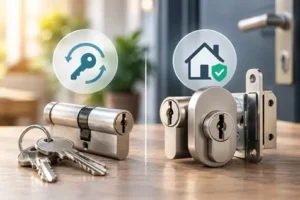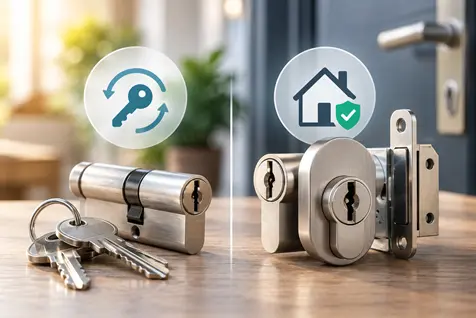
When you need new keys or want to improve control over access to your home, replacing every lock may not be necessary. Rekeying can sometimes achieve the same practical goal while keeping the existing hardware. Learn how the two options differ and when each one may be the better choice.
Rekeying vs Replacing a Lock: Which Option Makes More Sense?
You want the old keys to your house to stop working. The obvious solution seems simple: remove the locks and install new ones. But there may be another option.
Depending on the type and condition of your locks, they may be rekeyed instead.
Although rekeying and replacement can both result in a new set of working keys, they are not the same service. One changes how the existing lock responds to a key, while the other changes the physical hardware. Knowing the difference can help homeowners avoid unnecessary work and choose a solution that fits the actual problem.
What Is Rekeying?
Rekeying modifies a compatible lock so that it works with a different key. The main lock remains installed, but its internal key configuration is changed. Afterward, the previous key should no longer operate that lock.
This makes rekeying particularly useful when the hardware itself is in good condition but control over existing keys has become uncertain.
For example, imagine buying a home with perfectly functional locks. You receive several keys at closing, but you have no way of knowing whether additional copies still exist. If the locks are suitable for rekeying, there may be no reason to throw away otherwise good hardware simply to establish a new set of keys.
When Does Rekeying Make Sense?
Moving into a previously occupied property is one of the most obvious situations. The same applies after a tenant moves out of a rental property, subject to the owner’s requirements and local rules.
A lost key can be another reason. If you believe the missing key could eventually be connected to your property, changing the key configuration can remove the usefulness of that old copy.
Rekeying may also help households that have accumulated too many uncontrolled copies over time. Perhaps keys were previously given to contractors, cleaners, former partners, or other people who no longer require access.
Instead of trying to recover every copy, starting again with a new key configuration may be simpler.
When Is Replacement the Better Choice?
Rekeying solves an access-control problem, but it does not transform an old or damaged lock into new hardware.
If a lock is heavily worn, corroded, physically damaged, or regularly malfunctioning, keeping it may provide little benefit. Replacement allows the underlying mechanical issue to be addressed at the same time.
The same is true when homeowners want to upgrade their security. An older lock cannot gain the physical features of a newer design simply through rekeying.
Replacement is also necessary when you want a fundamentally different type of locking system. Moving from traditional hardware to a smart lock, for example, involves more than changing which key operates the existing cylinder.
Which Option Costs Less?
People frequently choose rekeying because it can avoid the cost of purchasing an entirely new lock. However, there is no universal price difference.
Costs vary according to the type and number of locks, their compatibility, labour requirements, location, and whether additional work is necessary. Replacing inexpensive hardware could sometimes be straightforward, while working with several specialized locks may involve different considerations.
The best way to compare the two options is to request a clear estimate based on the actual doors and locks involved.
A cheaper solution is useful only if it also addresses the reason you requested the work.
Think About the Condition of the Hardware
Before deciding, operate the lock several times and pay attention to how it feels.
Does the key enter easily? Does it turn smoothly? Is the cylinder secure, or does it move? Does the door need to be pushed or lifted before the bolt engages?
Problems like these deserve investigation.
Importantly, not every difficulty is caused by the lock. A door that has moved out of alignment can put pressure on otherwise functional hardware. Replacing a lock without addressing the alignment could leave you with the same frustrating symptoms.
An inspection can help separate a key-control issue from a mechanical or door-related problem.
One Key for Multiple Doors?
Some homeowners become interested in rekeying because they have accumulated a large collection of keys for different entrances.
In certain compatible systems, locks may be configured so that one key operates more than one door. This can reduce the number of keys a homeowner needs to carry.
However, compatibility and security requirements need to be considered. Not every lock can or should be configured this way. A locksmith can determine what is possible with the hardware installed at the property.
Convenience should not come at the expense of appropriate access control.
What If You Lost a Key?
If a key has disappeared, ask yourself two questions: where was it probably lost, and could somebody identify the property it belongs to?
A key that is almost certainly somewhere in your own house creates a different level of concern from a key stolen together with a bag containing your address.
If there is a meaningful possibility of unauthorized access, simply making another copy does not solve the problem. The missing key still works.
Rekeying or replacement can address that issue by making the old key unusable.
Consider Future Plans
Your decision can also depend on what you intend to do with the property.
If you are already planning to replace the front door soon, investing heavily in temporary lock hardware may make little sense. On the other hand, if you recently renovated the entrance and have high-quality locks in excellent condition, rekeying may allow you to retain that investment.
Landlords and property managers may have different priorities again, particularly when access needs to be reset between occupants.
There is no single answer that applies to every property.
A Locksmith Can Compare Both Options
Rather than requesting a new lock automatically, explain the problem you are trying to solve.
If your concern is that unknown copies of the key exist, say so. If the mechanism sticks, mention that. If your priority is upgrading security, make that clear as well.
This information from locksmith Zelzate helps determine whether rekeying, repair, adjustment, or complete replacement is appropriate.
Choose Based on the Problem, Not the Terminology
Rekeying and replacing a lock can both provide homeowners with new keys, but they solve different problems.
Rekeying is often worth considering when the existing hardware works well and the main goal is to prevent old keys from being used. Replacement makes more sense when the lock is worn, damaged, outdated, incompatible with your needs, or when you want to install a different security system openen huis
Instead of assuming that new keys require new locks, evaluate the condition of what you already have. The right solution is the one that restores control over access while keeping the door secure, dependable, and convenient to use.
Also Read-JC Slang Meaning in Text: What Does JC Mean in Chat?