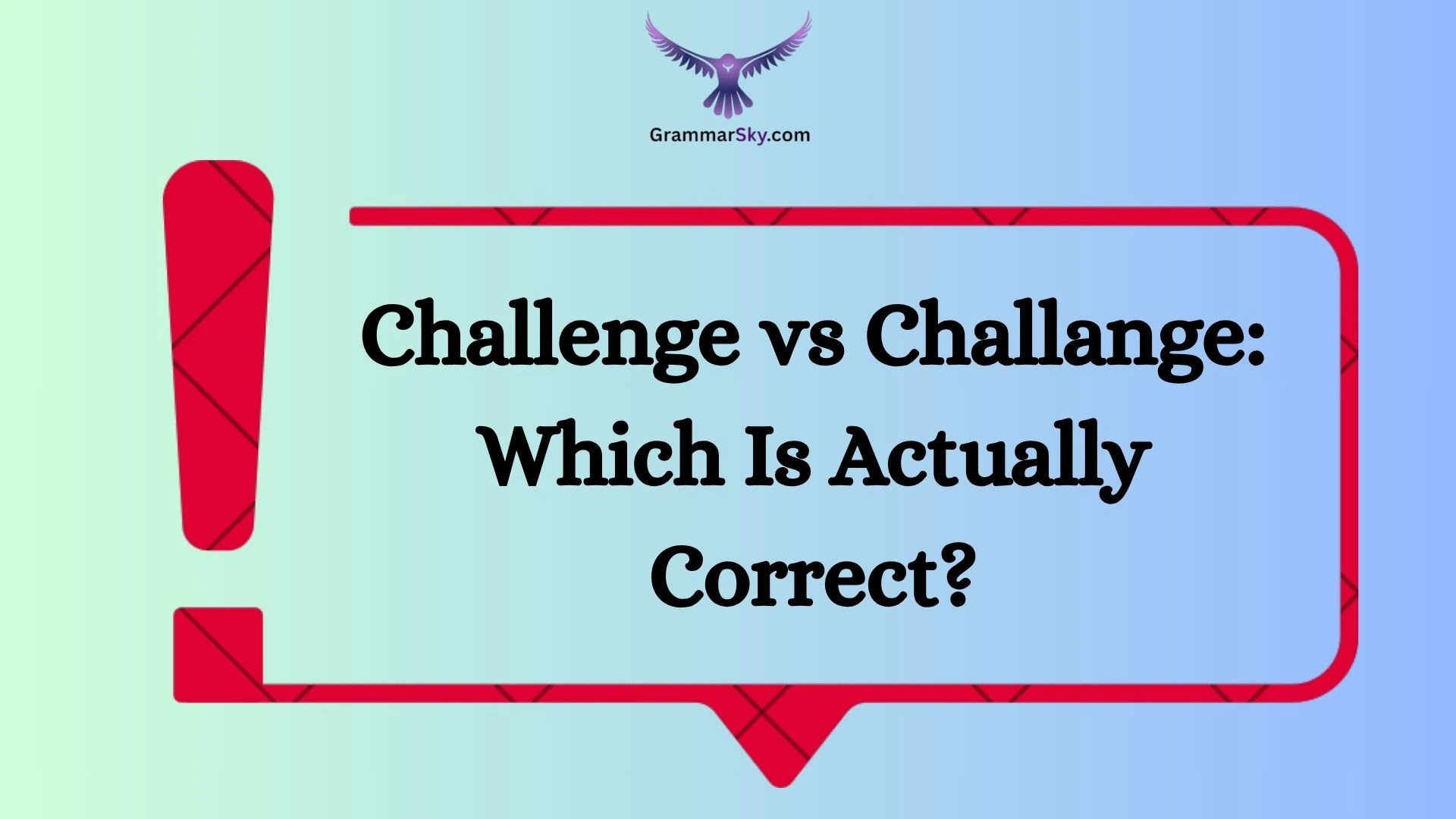
Choosing between Challenge vs Challange can confuse many writers, but the correct spelling is easy to remember.
The words Challenge and Challange often appear in online searches because many people accidentally misspell the correct form. However, Challenge is the only accepted spelling in English, while Challange is simply a spelling mistake. Whether you’re writing an email, essay, blog post, business document, or social media caption, using the correct spelling helps you communicate clearly and professionally. Learning the difference also improves your grammar, strengthens your writing skills, and helps you avoid common errors that can reduce your credibility. This guide explains the correct spelling, meaning, pronunciation, usage, and practical examples so you can confidently use Challenge in every situation.
Understanding the difference between Challenge and Challange is important for students, professionals, and anyone who writes in English. The noun and verb Challenge refers to a difficult task, competition, objection, or an invitation to test someone’s ability. It is widely used in academic writing, business communication, sports, and everyday conversations. In contrast, Challange does not appear in standard English dictionaries because it is an incorrect spelling caused by replacing the second “e” with an “a.” By remembering the correct spelling and practicing it in sentences, you can improve your vocabulary, avoid embarrassing mistakes, and write with greater accuracy, confidence, and professionalism every time.
Challenge vs Challange: The Quick Answer
If you’re in a hurry, here is the answer in one table.
| Word | Correct? | Meaning |
| Challenge | Yes | A difficult task, competition, or invitation to prove ability |
| Challange | No | Misspelling of “challenge” |
Example:
- I enjoy a good challenge.
- I enjoy a good challange.
No major English dictionary recognizes challange as a proper English word.
What Does the Word “Challenge” Mean?
The word challenge has several meanings. It can function as both a noun and a verb.
Challenge as a Noun
As a noun, a challenge is something difficult that requires effort or skill.
Examples:
- Learning a new language is a challenge.
- Starting a business can be a challenge.
- Running a marathon is a physical challenge.
In simple terms, a challenge is a problem or task that pushes you beyond your comfort zone.
Challenge as a Verb
As a verb, challenge means to question, dispute, or invite someone to compete.
Examples:
- She challenged the decision.
- The boxer challenged the champion.
- You should challenge yourself every day.
Dictionary Definitions of Challenge
Leading dictionaries define challenge in similar ways.
| Dictionary | Definition |
| Merriam-Webster | A difficult task or an invitation to compete |
| Cambridge Dictionary | Something needing great effort and determination |
| Oxford Dictionary | A call to take part in a contest or difficult situation |
These definitions all share one idea: a challenge involves effort, testing, or competition.
Is “Challange” a Real Word?
No.
Challange is not a real English word.
It does not appear as an accepted spelling in:
- Dictionaries
- Academic writing guides
- Grammar textbooks
- Professional publications
- Major style manuals
When you type challange, most spell-checkers automatically suggest challenge.
The confusion exists because English spelling is not always phonetic. People often write words the way they sound instead of the way they are spelled.
Why Do People Spell Challenge as Challange?
This mistake is surprisingly common. There are several reasons behind it.
The Pronunciation Creates Confusion
The ending of challenge sounds similar to the ending of words like:
- change
- arrange
- exchange
- range
Because these words contain “ange,” people naturally assume that challenge follows the same pattern.
However, English loves exceptions.
The word is spelled:
Chall + enge
Not:
Chall + ange
Fast Typing Leads to Errors
Many spelling mistakes happen simply because people type quickly.
Think about how often you:
- text on your phone
- write social media posts
- send emails in a hurry
A single misplaced letter can turn challenge into challange.
English Learners Often Spell Words Phonetically
Many learners write words exactly as they hear them.
For example:
| Incorrect | Correct |
| Definately | Definitely |
| Recieve | Receive |
| Seperate | Separate |
| Occured | Occurred |
| Challange | Challenge |
This process is called phonetic spelling, and it is one of the main reasons spelling errors happen.
The Origin and History of the Word Challenge
Understanding where a word comes from often makes it easier to remember.
The word challenge has a fascinating history.
Latin Origins
The word ultimately comes from the Latin word:
calumnia
which meant:
- accusation
- false charge
- complaint
Over time, the meaning evolved.
Old French Influence
The Old French word:
chalenge
meant:
- dispute
- accusation
- claim
English later adopted the term and gradually changed its spelling to challenge.
How the Meaning of Challenge Changed Over Time
Several hundred years ago, a challenge usually referred to:
- questioning someone’s rights
- making an accusation
- inviting someone to a duel
Today, the meaning is much broader.
A challenge can refer to:
- a difficult situation
- a competition
- a personal goal
- an obstacle
- questioning a decision
Language changes over time, and challenge is a perfect example of that evolution.
How to Spell Challenge Correctly Every Time
If you frequently write challange, don’t worry. There are simple ways to remember the correct spelling.
Memory Trick Number One
Think of this sentence:
Every challenge needs energy.
Notice the word energy starts with en.
The spelling is:
chall + enge
The “en” can remind you of “energy.”
Memory Trick Number Two
Break the word into pieces:
chal + lenge
Saying the word slowly often helps.
Memory Trick Number Three
Use It Frequently
The more often you use a word, the easier it becomes to remember.
Try writing:
- challenge yourself
- a new challenge
- a difficult challenge
- challenge accepted
Repetition builds memory.
Common Phrases Using the Word Challenge
English speakers use this word in many expressions.
Challenge Accepted
This phrase means:
“I agree to try something difficult.”
Example:
My friends dared me to climb the mountain and I said, “Challenge accepted.”
Rise to the Challenge
This means successfully dealing with a difficult situation.
Example:
The company rose to the challenge during the economic crisis.
Face a Challenge
This means dealing with a problem directly.
Example:
Every business owner faces challenges.
Take On a Challenge
This means choosing to do something difficult.
Example:
She took on the challenge of learning Japanese.
Challenge Yourself
This means pushing yourself beyond your comfort zone.
Example:
If you want to grow, challenge yourself regularly.
Read This Also: Training vs Trainning: Which One Is Correct?
Examples of Challenge in Everyday Life
The word appears almost everywhere.
At School
- Passing final exams is a challenge.
- Writing a research paper can be challenging.
- Learning mathematics requires persistence.
At Work
- Managing a team is a challenge.
- Meeting deadlines can be difficult.
- Starting a new career is often challenging.
In Sports
- Running a marathon is a major challenge.
- Athletes challenge themselves every day.
- Winning championships requires overcoming challenges.
In Personal Development
- Breaking bad habits is challenging.
- Learning discipline is a challenge.
- Building confidence takes effort.
Challenge as a Noun and Verb
Many words only serve one purpose. Challenge does two jobs.
| Part of Speech | Example |
| Noun | This project is a challenge. |
| Verb | I challenge your argument. |
Understanding the difference improves your grammar and writing.
Challenge in Business and Leadership
In the business world, the word appears constantly.
Companies face challenges such as:
- inflation
- competition
- technological change
- staffing shortages
- cybersecurity threats
Great leaders do not avoid challenges. They solve them.
Case Study: Netflix
Netflix began as a DVD rental company.
The rise of online streaming created a major challenge.
Instead of resisting change, the company transformed its business model and became one of the world’s leading streaming platforms.
The lesson is simple:
Challenges often create opportunities.
Challenge in Education
Teachers frequently use challenges to motivate students.
Examples include:
- reading challenges
- science challenges
- coding challenges
- mathematics competitions
Research consistently shows that students learn more when tasks are difficult but achievable.
A challenge stimulates:
- creativity
- problem-solving
- perseverance
- confidence
Challenge in Psychology
Psychologists often discuss the relationship between challenge and growth.
A life without challenges can become boring.
Too many challenges can become overwhelming.
The ideal situation lies somewhere in the middle.
This idea is sometimes called the Goldilocks Principle.
The task should be:
- not too easy
- not too difficult
- just challenging enough
This is where people often experience growth.
Why Challenges Matter in Life
Challenges are uncomfortable.
Yet they are also necessary.
Think about it:
- You become stronger by overcoming difficulties.
- You gain experience by solving problems.
- You build confidence through achievement.
Every major accomplishment begins with a challenge.
As the old saying goes:
Smooth seas never made skilled sailors.
Why Correct Spelling Matters
Some people wonder whether a single letter really matters.
It does.
Correct spelling affects:
Credibility
Misspelled words can make writing look careless.
Professionalism
Employers often judge attention to detail.
Search Visibility
Correct spelling helps people find your content.
Academic Success
Teachers and professors usually deduct marks for spelling errors.
Small mistakes sometimes leave a big impression.
Challenge vs Challange in Google Searches
Thousands of users search for challange every year.
Why?
Because people:
- type quickly
- spell by sound
- rely heavily on autocorrect
Search engines are smart enough to understand these mistakes.
If you search for challange, Google usually displays results for challenge.
However, relying on search engines to fix mistakes is not a good habit.
Learning the correct spelling improves communication.
Commonly Misspelled Words Similar to Challenge
The English language contains many troublesome words.
| Incorrect | Correct |
| Accomodate | Accommodate |
| Definately | Definitely |
| Goverment | Government |
| Seperate | Separate |
| Tommorow | Tomorrow |
| Recieve | Receive |
| Challange | Challenge |
Even native speakers make these mistakes.
The key is awareness and practice.
Challenge vs Challange: Side-by-Side Comparison
| Feature | Challenge | Challange |
| Correct English spelling | Yes | No |
| Found in dictionaries | Yes | No |
| Acceptable in formal writing | Yes | No |
| Used in professional communication | Yes | No |
| Recommended spelling | Always | Never |
The comparison leaves little room for doubt.
Challenge wins every time.
How to Avoid Spelling Mistakes Like Challange
Here are practical ways to improve your spelling.
Read More
Reading exposes you to correct spelling repeatedly.
Use Spell-Check Tools
Programs such as:
- Microsoft Word
- Grammarly
- Google Docs
can catch many errors.
Keep a Personal List
Write down words you often misspell.
Proofread Slowly
Reading too quickly makes mistakes invisible.
Read Aloud
Hearing your writing often reveals errors.
FAQs
1. Is “Challange” a correct spelling?
No, “Challange” is not the correct spelling. The correct word is “Challenge,” which is used in English to describe a difficult task, competition, or invitation to prove one’s ability.
2. Why do people misspell “Challenge” as “Challange”?
Many people write “Challange” because the pronunciation can make the middle vowel sound unclear. However, standard English dictionaries recognize only “Challenge” as the correct spelling.
3. How can I remember the correct spelling of “Challenge”?
A simple trick is to remember that “Challenge” contains “enge” at the end, not “ange.” Reading, writing, and using the word regularly will help reinforce the correct spelling.
4. Is “Challenge” used as both a noun and a verb?
Yes. As a noun, “Challenge” refers to a difficult task or competition. As a verb, it means to question, invite someone to compete, or test someone’s abilities.
5. Which spelling should I use in academic and professional writing?
You should always use “Challenge.” The spelling “Challange” is considered a spelling mistake and should be avoided in school assignments, business documents, emails, and professional communication.
Conclusion
Understanding the difference between “Challenge” and “Challange” is simple once you know that “Challenge” is the only correct spelling in modern English. Whether you’re writing an essay, email, report, or social media post, using the correct spelling improves your grammar, credibility, and professionalism.
By remembering that “Challange” is simply a common misspelling, you can avoid unnecessary writing errors. Practice using “Challenge” in everyday conversations and written communication to build confidence and ensure your English writing remains clear, accurate, and polished.