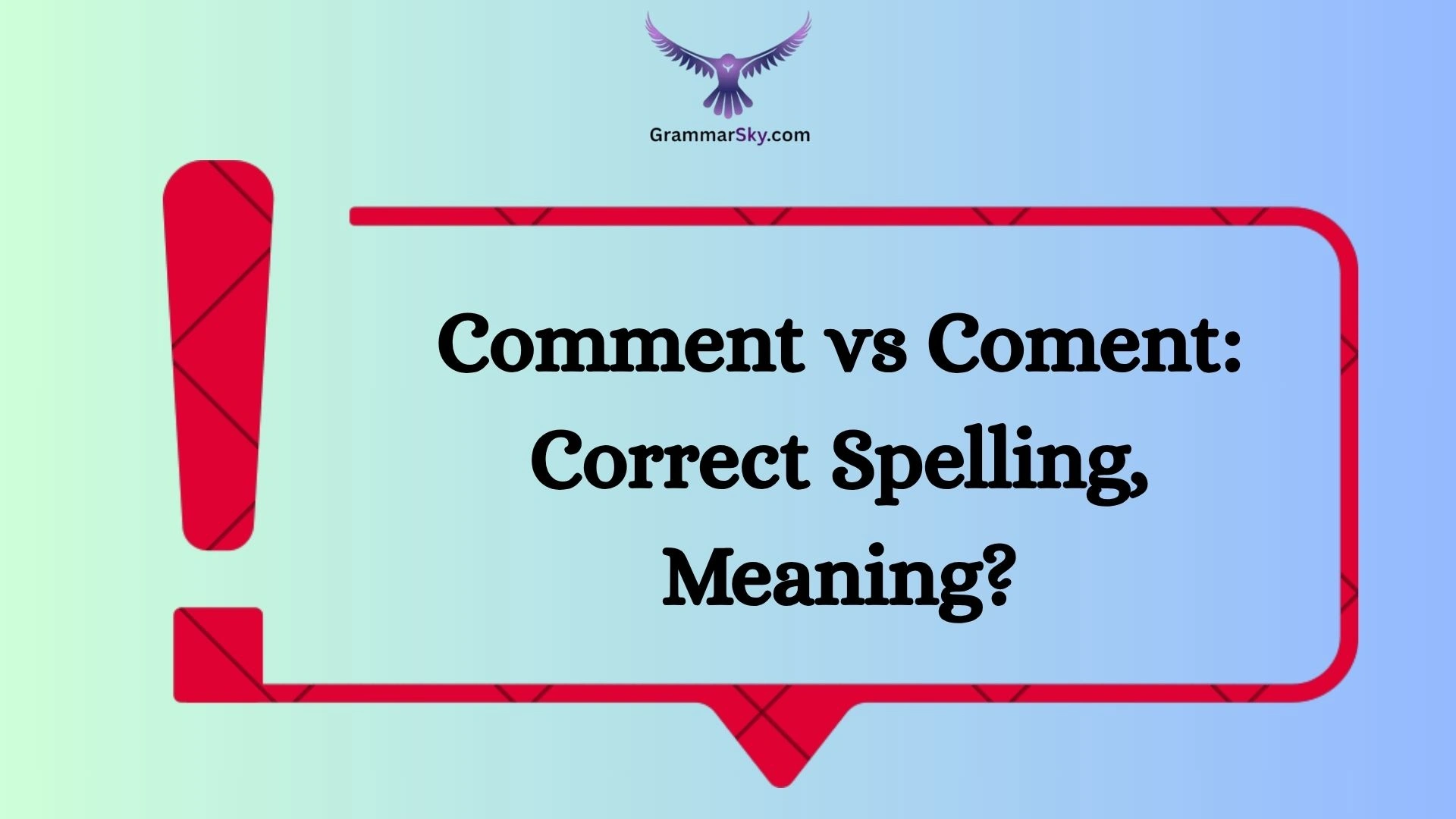
When writing online or in professional communication, the difference between Comment vs Coment can confuse many people.
The debate between Comment and Coment is common because both words look similar at first glance. However, only one of them is recognized as the correct English spelling. Whether you’re posting on social media, writing a blog, sending emails, or leaving feedback on a website, using the right spelling is important. Small spelling mistakes can affect the quality of your content and create confusion for readers. Learning the difference can help you communicate more clearly and professionally in any situation.
In this guide, we’ll explain the meaning of Comment, why Coment is considered a misspelling, and how to use the correct term in everyday writing. You’ll also discover helpful examples, common mistakes, usage tips, and practical advice to improve your English grammar, spelling skills, and overall communication. By the end, you’ll know exactly when and how to use Comment correctly, helping you write with greater confidence and avoid one of the most common spelling errors online.
Is It Comment or Coment?
The answer is straightforward:
| Word | Correct? | Meaning |
| Comment | Yes | A remark, opinion, statement, or feedback |
| Coment | No | Misspelling of “comment” |
Whenever you want to refer to an opinion, feedback, or written response, you should use comment.
Examples
Please leave a comment below.
The teacher made a helpful comment about my essay.
Please leave a coment below.
She wrote a coment on the post.
The second set of examples contains spelling mistakes.
What Does the Word Comment Mean?
The word comment can function as both a noun and a verb.
Comment as a Noun
A comment is:
- A remark
- An opinion
- Feedback
- An observation about something
Examples:
- Her comment made everyone laugh.
- I appreciated your comment on my presentation.
- The article received hundreds of comments.
Comment as a Verb
To comment means to express an opinion or make a statement.
Examples:
- The company refused to comment on the rumors.
- Would you like to comment on the proposal?
- She commented on the latest news.
Dictionary Definitions of Comment
Several trusted dictionaries define the word similarly.
Merriam-Webster
A comment is a note or observation expressing an opinion.
Cambridge Dictionary
A spoken or written opinion about something.
Oxford Dictionary
A verbal or written remark expressing a reaction or opinion.
Although the wording differs slightly, all definitions share one idea: a comment is an expression of thought or feedback.
How to Pronounce Comment
The pronunciation of comment is:
American English: /KOM-ent/
British English: /KOM-ent/
The pronunciation sounds like there is only one “m,” which partly explains why some people mistakenly spell it as coment.
English spelling often contains double letters that are not heavily emphasized when spoken.
For example:
| Pronunciation | Correct Spelling |
| com-it | commit |
| run-ing | running |
| begin-er | beginner |
| com-ent | comment |
English pronunciation and spelling do not always perfectly match.
Why Do People Write Coment Instead of Comment?
Spelling mistakes happen for many reasons.
Typing Too Fast
People often type quickly online and accidentally omit one letter.
Phonetic Spelling
Many writers spell words exactly how they sound.
Since comment sounds like “coment,” people naturally assume it has one “m.”
Lack of Familiarity
English learners frequently struggle with double consonants.
Words like:
- Accommodation
- Occurred
- Committee
- Recommend
- Comment
are among the most commonly misspelled words in English.
Mobile Keyboard Errors
Autocorrect doesn’t always catch mistakes, especially if the word resembles another valid spelling pattern.
The History and Origin of the Word Comment
The word comment has a long history.
It comes from the Latin word:
commentum
which means:
- Interpretation
- Explanation
- Invention
- Reflection
The word later entered Old French and then Middle English.
Over hundreds of years, the spelling evolved into the modern form:
comment
The double “m” has remained part of the word throughout its history.
That means coment has never been considered the standard spelling.
How to Use Comment Correctly in Sentences
Using Comment as a Noun
Examples:
- His comment changed my perspective.
- The editor added a comment in the document.
- I liked your comment on social media.
Using Comment as a Verb
Examples:
- Journalists asked the minister to comment.
- She commented on every photo.
- The spokesperson declined to comment.
Examples of Comment in Everyday Situations
In School
The teacher wrote a positive comment on my assignment.
At Work
The manager made an important comment during the meeting.
On Social Media
Thousands of users commented on the video.
In News Reports
The actor refused to comment on the allegations.
In Customer Reviews
Customers often comment on delivery speed.
Comment in the Digital World
Today, the word comment appears everywhere online.
You see it on:
- YouTube
- Blogs
- News websites
- E-commerce stores
The internet has turned commenting into a daily activity.
Examples
- Comment section
- User comments
- Featured comments
- Pinned comments
- Public comments
Billions of comments are posted online every year.
According to data published by YouTube, users leave millions of comments on videos every day, making comments one of the most common forms of online interaction.
Common Phrases That Use the Word Comment
English uses the word in many expressions.
No Comment
Used when someone refuses to answer.
Example:
The celebrity said, “No comment.”
Comment On
To express an opinion.
Example:
Can you comment on this issue?
Make a Comment
To say something about a topic.
Example:
He made a funny comment.
Public Comment
Feedback from the general public.
Example:
The proposal is open for public comment.
Comment Section
The area where users leave feedback online.
Why Coment Is Incorrect
The spelling coment is not accepted by:
- Oxford Dictionary
- Merriam-Webster
- Cambridge Dictionary
- Collins Dictionary
- American Heritage Dictionary
No major English dictionary recognizes coment as a standard word.
Why the Double M Matters
English has many words with doubled consonants.
Examples:
| Correct | Incorrect |
| Comment | Coment |
| Recommend | Recomend |
| Committee | Comitee |
| Accommodation | Acommodation |
| Occasion | Ocassion |
Removing one letter changes the correct spelling.
Comment vs Coment: Side-by-Side Comparison
| Feature | Comment | Coment |
| Correct English word | Yes | No |
| Found in dictionaries | Yes | No |
| Used in schools | Yes | No |
| Accepted in professional writing | Yes | No |
| Appears in grammar books | Yes | No |
| Recommended for business writing | Yes | No |
The verdict is simple:
Comment wins every time.
Why Correct Spelling Matters
Some people think spelling mistakes don’t matter.
In reality, they often do.
Research from several marketing studies shows that spelling errors can reduce trust and credibility online.
A business website with noticeable spelling mistakes may appear less professional.
A resume containing spelling errors may create a poor first impression.
Even social media posts receive criticism when common words are misspelled.
Correct spelling demonstrates:
- Attention to detail
- Professionalism
- Credibility
- Strong communication skills
Read this Also: Nonresponsive vs Unresponsive: Differences, Meanings?
Case Study: One Small Typo, Big Consequences
A small business once sent an email campaign asking customers to:
“Leave a coment below.”
Several customers replied and pointed out the mistake.
Although the error was minor, it distracted readers from the actual message.
This example highlights an important lesson:
People notice spelling mistakes more than you might expect.
A single missing letter can damage credibility.
Words Commonly Misspelled Like Comment
English contains many tricky words.
Frequently Misspelled Words
| Incorrect | Correct |
| Coment | Comment |
| Adres | Address |
| Desicion | Decision |
| Comming | Coming |
| Definately | Definitely |
| Ocured | Occurred |
| Tommorow | Tomorrow |
| Seperate | Separate |
| Recomended | Recommended |
Double letters are often responsible for these mistakes.
Why Double Letters Are Difficult in English
English spelling evolved from several languages:
- Latin
- French
- Germanic languages
- Greek
As a result, spelling rules are not always logical.
For example:
- Beginning → double n
- Running → double n
- Committee → double m and double t
- Comment → double m
Unfortunately, there is no universal rule that explains every double letter.
Practice and exposure remain the best teachers.
How to Remember the Correct Spelling of Comment
Here are some memory tricks.
Trick One
Think of the phrase:
A comment has More Meaning.
The word more starts with “M.”
Two M’s.
Comment also has two M’s.
Trick Two
Remember this sentence:
I leave a comment, not a coment.
Repeating this phrase several times helps your brain remember the correct spelling.
Trick Three
Associate comment with another double-letter word:
- Comment
- Committee
- Common
All three contain double letters.
Common Situations Where People Use Comment
In Blogging
Readers leave comments at the bottom of articles.
In Education
Teachers write comments on assignments.
In Business
Managers make comments during meetings.
In Programming
Developers write comments inside code to explain how programs work.
In Government
Public comments help shape policies and regulations.
The word is extremely versatile.
Comment in Computer Programming
Many people don’t realize that comment has another important meaning.
In programming, comments are notes written inside code.
They explain:
- What the code does
- Why a function exists
- How a section works
Example in Python
# Calculate total price
The line above is a comment.
Computers ignore comments, but humans use them to understand code.
This shows how widely the word is used beyond everyday conversation.
Common Mistakes to Avoid
Writing Coment in Professional Emails
Incorrect:
Thank you for your coment.
Correct:
Thank you for your comment.
Using Coment in Academic Papers
Professors expect correct spelling.
Always proofread before submitting assignments.
Ignoring Spell Check
Modern writing tools can catch many errors.
However, they are not perfect.
Always review your work manually.
Assuming Pronunciation Equals Spelling
English often breaks this rule.
Words do not always look exactly the way they sound.
Quick Grammar Guide for Comment
Singular Form
Comment
Example:
I left a comment.
Plural Form
Comments
Example:
The article received hundreds of comments.
Verb Forms
| Tense | Form |
| Base | Comment |
| Past | Commented |
| Present participle | Commenting |
| Third person singular | Comments |
FAQs
1. Is “Coment” a real English word?
No. Coment is not a recognized English word. It is a misspelling of Comment.
2. Which is correct: Comment or Coment?
Comment is the correct spelling in both American English and British English.
3. Why do people write “Coment” instead of “Comment”?
Most people write Coment because of a typing mistake, spelling confusion, or by accidentally leaving out one “m”.
4. Can I use “Coment” in formal writing?
No. You should always use Comment in academic, professional, and business writing to maintain accuracy and credibility.
5. How can I remember the correct spelling of “Comment”?
Remember that Comment has two “m” letters. Think of it as giving a “double m” message whenever you share your opinion or feedback.
Conclusion
Understanding the difference between Comment and Coment is simple once you know that Comment is the only correct spelling in English. While Coment may appear due to typing mistakes or spelling errors, it is not accepted in standard dictionaries or professional writing.
Using the correct spelling improves your grammar, writing accuracy, and communication skills. Whether you’re leaving a comment on social media, writing an email, or publishing a blog post, choosing the right word helps your content appear more professional, credible, and easy to understand.