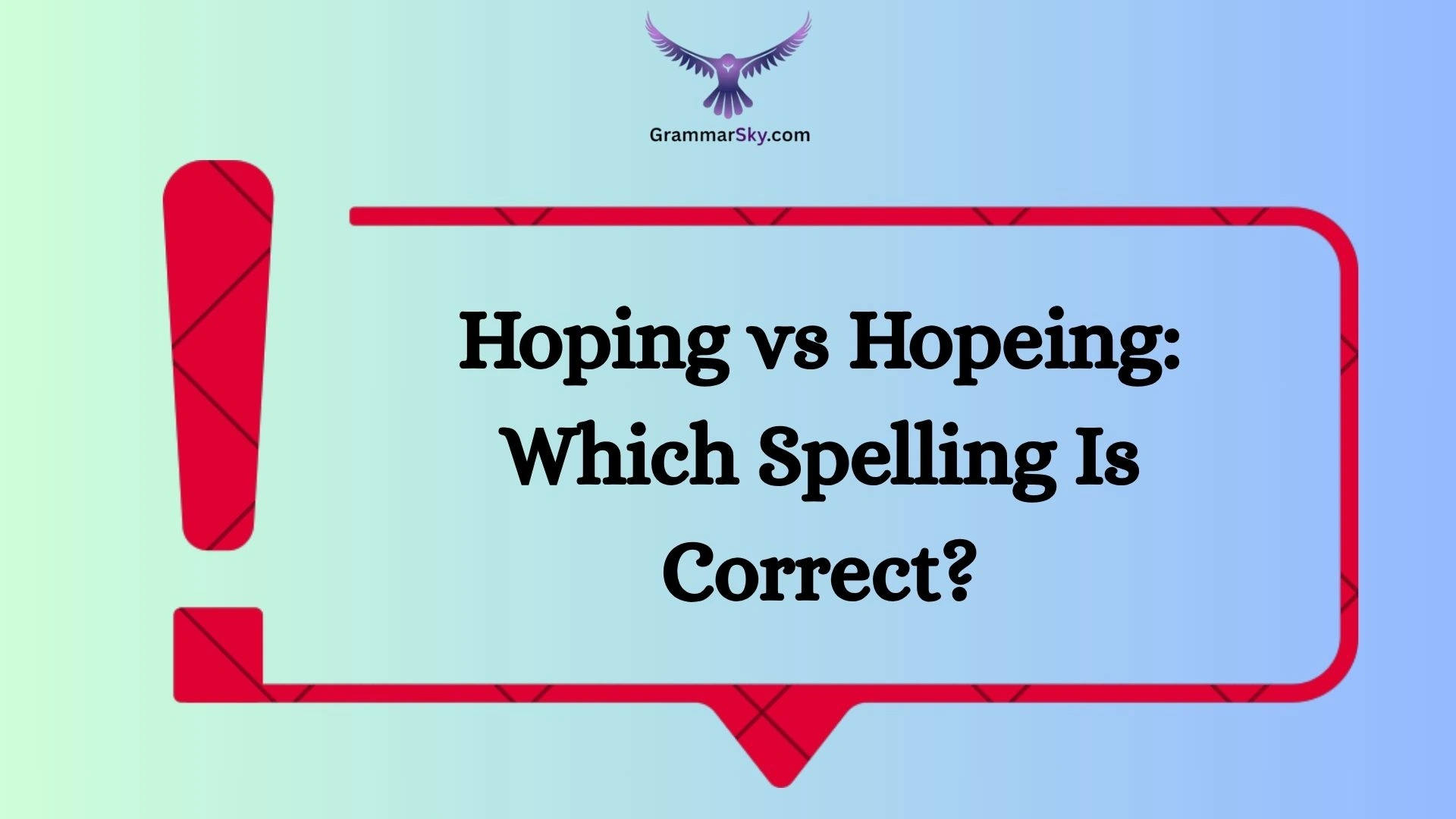
Hoping vs Hopeing is a common spelling confusion that occurs when people add suffixes to words ending in a silent.
The correct spelling is hoping, not hopeing. The word hoping means having a desire, expectation, or wish that something will happen in the future. It follows the common spelling rule where the final silent e is removed before adding the suffix -ing. For example, “I am hoping to get good news soon.” Many writers mistakenly use hopeing because they think every base word keeps its original form when adding -ing, but this spelling is incorrect in standard English grammar. Learning the difference between hoping and hopeing helps avoid common spelling mistakes and makes your writing clearer.
The confusion between hoping vs hopeing happens because the word hope already ends with the letter e, and many learners are unsure whether to keep or remove it. In American English, hoping is the accepted and widely used spelling, while hopeing is considered a misspelling. This spelling rule also applies to similar words like hoping, hoping for success, and hoping for better results, where the silent e disappears before adding -ing. Knowing when to remove the final e improves your vocabulary, writing accuracy, and confidence in using English correctly. Whether you are writing emails, articles, or daily messages, choosing hoping instead of hopeing ensures your sentences look professional and grammatically correct.
Is It Hoping or Hopeing?
The answer is straightforward:
| Word | Correct? | Meaning |
| Hoping | Correct | Feeling or expressing hope about something |
| Hopeing | Incorrect | Not recognized as a proper English spelling |
Correct Examples
- I am hoping for good news.
- She is hoping to get the promotion.
- They are hoping the weather improves.
Incorrect Examples
- I am hopeing for good news.
- She is hopeing to get the promotion.
- They are hopeing the weather improves.
In every situation, hoping is the proper spelling.
What Does Hoping Mean?
The word hoping comes from the verb hope, which means:
To desire something to happen and believe that it may happen.
Dictionary Definitions
According to major dictionaries:
- Merriam-Webster: To cherish a desire with anticipation.
- Cambridge Dictionary: To want something to happen or be true and believe it is possible.
- Oxford Learner’s Dictionaries: To want something to happen and think that it is possible.
Examples of Hope in Everyday Life
People use the word every day:
- Hoping for a new job.
- Hoping to pass an exam.
- Hoping for sunny weather.
- Hoping a loved one recovers quickly.
The word carries a sense of optimism and expectation.
Why Is Hopeing Incorrect?
The mistake comes from misunderstanding a basic English spelling rule.
English often removes a silent e before adding -ing.
The Formula
hope + ing
= hoping
Not:
hope + ing
= hopeing
The final e disappears.
This rule exists because the extra e isn’t needed to preserve the pronunciation.
The word hope already ends with a silent e, so English spelling conventions remove it before adding -ing.
The Silent E Rule Explained
One of the first spelling rules taught in English grammar is:
If a verb ends in a silent “e,” drop the “e” before adding “-ing.”
Examples
| Base Verb | Correct Form |
| hope | hoping |
| make | making |
| write | writing |
| save | saving |
| smile | smiling |
| move | moving |
| dance | dancing |
Notice the pattern.
The silent e disappears every time.
Why Does English Drop the Silent E?
English spelling developed over centuries from Germanic, French, and Latin influences. Over time, writers and grammarians simplified certain word forms.
Removing the silent e serves two purposes:
- It avoids unnecessary letters.
- It keeps spelling patterns consistent.
For example:
| Incorrect | Correct |
| writeing | writing |
| saveing | saving |
| makeing | making |
| smileing | smiling |
If English kept the silent e in every word, many spellings would become unnecessarily long and awkward.
Why Do So Many People Write Hopeing?
The mistake is surprisingly common.
Several factors contribute to the confusion.
People Spell Words the Way They Sound
The word hope clearly contains an e, so many writers instinctively keep it.
English Has Many Exceptions
English isn’t always predictable.
Words like:
- seeing
- agreeing
- canoeing
keep certain vowels, which makes learners question other spellings.
Fast Typing
Typing quickly often causes mistakes. Since hopeing looks believable, people sometimes overlook it.
English Learners Apply Rules Incorrectly
Someone learning English may assume:
hope + ing = hopeing
The assumption seems logical even though it breaks the silent e rule.
Understanding the Grammar Behind Hoping
The word hoping can function in two ways:
Present Participle
Example:
She is hoping for better results.
Gerund
Example:
Hoping for a miracle kept him motivated.
The -ing form allows the word to act as a verb or a noun depending on the sentence.
Examples of Hoping in Sentences
Daily Conversation
- I’m hoping the traffic isn’t too bad.
- We’re hoping for a quick solution.
- She’s hoping to buy a new house.
Business Writing
- The company is hoping to increase sales.
- Investors are hoping for strong earnings.
Academic Writing
- Researchers are hoping to discover new treatments.
- Scientists are hoping the study will answer important questions.
Personal Situations
- Parents are hoping their children succeed.
- Athletes are hoping to win championships.
Incorrect Examples of Hopeing
Here are examples you should avoid.
I am hopeing to visit New York.
We are hopeing for rain.
She is hopeing to finish the project.
Correct Versions
I am hoping to visit New York.
We are hoping for rain.
She is hoping to finish the project.
Exceptions to the Silent E Rule
English loves exceptions.
Some verbs keep the e when adding -ing.
Examples
| Base Word | -ing Form |
| dye | dyeing |
| singe | singeing |
| age | ageing (British usage) |
| see | seeing |
| agree | agreeing |
| flee | fleeing |
These exceptions happen for specific reasons.
To Avoid Confusion
Consider:
- dyeing = coloring fabric
- dying = approaching death
Keeping the e changes the meaning entirely.
Double Vowel Endings
Words like:
- agree
- see
- flee
already end in two vowels, so dropping one would make pronunciation awkward.
Read This Also: Bellies vs Bellys: Which One Is Correct?
Why Hope Is Not an Exception
The word hope doesn’t meet any of the exception rules.
- It has a silent e.
- Removing the e doesn’t change pronunciation.
- The new word remains easy to read.
Therefore:
hope → hoping
The spelling never becomes:
hope → hopeing
Memory Tricks to Remember Hoping
Spelling rules are easier to remember with simple tricks.
Trick One: Drop Before You Add
If the word ends in a silent e, remove it.
hope
↓
hop
↓
hoping
Trick Two: Compare Similar Words
| Base Word | Correct Form |
| smile | smiling |
| save | saving |
| move | moving |
| dance | dancing |
| hope | hoping |
The pattern stays consistent.
Trick Three: Say It Aloud
You pronounce:
- hoping
You don’t pronounce:
- hope-ing.
The extra e creates an unnecessary visual break.
Common Words People Misspell the Same Way
The hopeing mistake belongs to a larger group of spelling errors.
| Incorrect | Correct |
| makeing | making |
| moveing | moving |
| smileing | smiling |
| liveing | living |
| saveing | saving |
| writeing | writing |
| useing | using |
| closeing | closing |
Learning one rule helps you avoid many mistakes.
Case Study: Why One Letter Matters
Imagine two job applicants.
Applicant One
I am hopeing to contribute to your company.
Applicant Two
I am hoping to contribute to your company.
The second sentence appears more polished and professional.
Hiring managers often notice spelling errors because they signal:
- Lack of attention to detail
- Poor proofreading habits
- Weak written communication
One extra letter may seem insignificant, yet it can shape a reader’s impression.
Does Spell Check Always Catch Hopeing?
Usually, yes.
Popular tools like:
- Microsoft Word
- Google Docs
- Grammarly
typically flag hopeing as incorrect.
However, no tool is perfect.
Good writers still proofread their work manually.
Is Hopeing Ever Accepted in British English?
No.
Some spellings differ between American and British English:
| American | British |
| color | colour |
| organize | organise |
| traveled | travelled |
However, hoping remains the correct spelling in both forms of English.
There is no accepted version of hopeing.
Is Hopeing in Any Dictionary?
Major dictionaries recognize only hoping.
If a word doesn’t appear in authoritative dictionaries, it’s generally not considered standard English.
Why Correct Spelling Matters in Digital Writing
The internet moves quickly. Readers often judge content within seconds.
Spelling errors can:
- Reduce trust.
- Hurt credibility.
- Make content look unprofessional.
- Distract readers from the message.
In Blogging
A single spelling error may increase bounce rates because readers question the accuracy of the content.
In Business
Mistakes in emails and proposals can damage professional reputation.
In School
Teachers often deduct points for repeated spelling errors.
Small details matter.
Quick Rules for Adding -ing to Verbs
Rule One: Drop the Silent E
| Verb | New Form |
| hope | hoping |
| make | making |
| write | writing |
Rule Two: Double Certain Consonants
| Verb | New Form |
| run | running |
| sit | sitting |
| swim | swimming |
Rule Three: Keep Double Vowels
| Verb | New Form |
| see | seeing |
| agree | agreeing |
| flee | fleeing |
Understanding these patterns makes English spelling much easier.
FAQs
1. Is “hoping” or “hopeing” the correct spelling?
The correct spelling is hoping. The word hoping follows the common English spelling rule where the final “e” is dropped before adding “-ing” to a verb ending in a silent e. Hopeing is an incorrect spelling and should be avoided in formal writing.
2. Why is “hopeing” considered wrong?
Hopeing is incorrect because English spelling rules usually remove the silent e when adding “-ing” to words like hope. This creates the correct form hoping, which keeps the pronunciation and meaning of the original verb.
3. What does “hoping” mean in English?
Hoping means having a wish, desire, or expectation that something good will happen. It is the present participle form of the verb hope and is often used when talking about future possibilities or positive expectations.
4. Can “hoping” be used in professional writing?
Yes, hoping is completely acceptable in professional writing when used correctly. For example, phrases like “I’m hoping to hear from you soon” or “We are hoping for positive results” are common in emails and workplace communication.
5. How can I remember the difference between hoping and hopeing?
A simple way to remember is: when a verb ends with a silent e, remove the e before adding “-ing.” Therefore, hope + ing = hoping, not hopeing. This rule also applies to words like make → making and write → writing.
Conclusion
Understanding the difference between hoping vs hopeing helps improve your English spelling and grammar accuracy. The correct form is always hoping, while hopeing is a common spelling mistake caused by forgetting the silent e rule. Learning this simple pattern makes your writing clearer and more professional.
Whether you are writing a formal email, blog post, essay, or everyday message, using correct spelling builds confidence and improves communication. Remember that hope becomes hoping when adding “-ing” because the final e is removed. Mastering small spelling differences like this can make a big impact on your overall language skills.