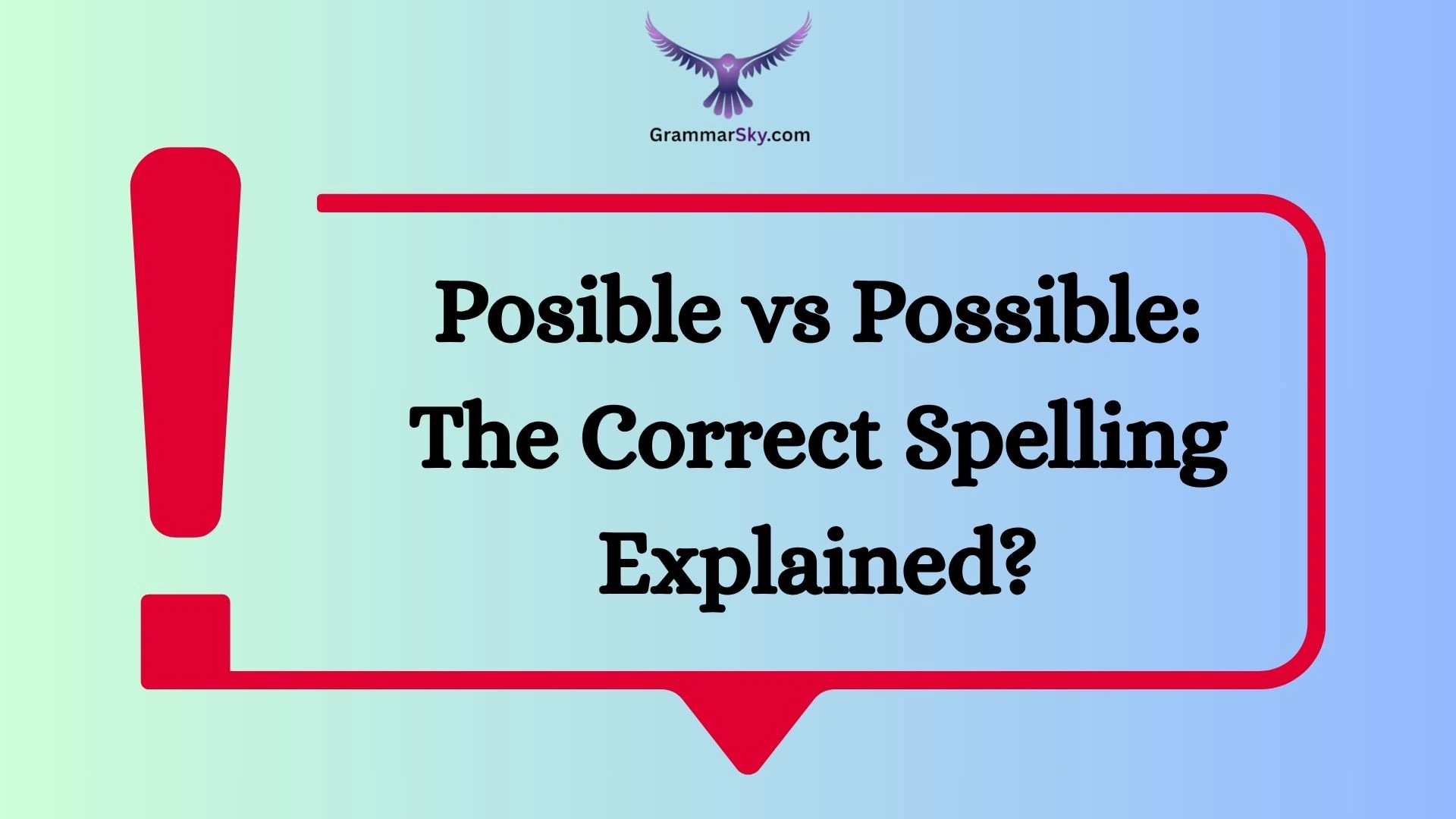
While finishing a quick office message, I noticed Posible vs Possible can confuse writers and hurt credibility in formal communication fast.
In my own workplace writing, I once typed “posible” during fast typing while sending a business email and updating a project management calendar. The spellchecker showed a red underline, and that quick pause reminded me how a tiny small letter difference can affect professional communication, official communication, and even business writing.
Many students, bloggers, professionals, English learners, and language learners face this common confusion because the similar words sound the same during keyboard typing or while managing projects, scheduling meetings, and coordinating online bookings. In Spanish, the correct spelling in Spanish is “posible,” so this language influence often creates bilingual confusion when people write in English across digital platforms, communication platforms, and online writing tasks.
The real answer comes from standard grammar rules, English grammar, English spelling, and English writing rules recognized in US English, UK English, British English, and American English. The correct spelling, proper spelling, and right form in standard English is always Possible, while “posible” becomes an incorrect form, spelling mistake, typing error, or spelling error.
This spelling trap creates grammar confusion, spelling confusion, word confusion, and a common spelling issue, especially for fast typists using autocorrect that sometimes changes words too late. During drafting emails, creating official documents, editing, proofreading, and text editing, choosing the correct word improves communication clarity, clear English usage, precise communication, written communication, and overall language accuracy in both formal communication and informal communication.
Quick Answer: Posible or Possible?
| Word | Correct in English? | Meaning |
| Possible | Yes | Something that can happen |
| Posible | No | Misspelling in English |
Correct Examples
- It’s possible to finish the project today.
- Is it possible to reschedule the meeting?
- We’ll reply as soon as possible.
Incorrect Examples
- It’s posible to finish the project today.
- Is it posible to reschedule the meeting?
The correct spelling always includes a double “s.”
What Does “Possible” Mean?
The word possible describes something that can happen, exist, or be achieved.
It’s an adjective. You use it when discussing opportunities, chances, options, or outcomes.
Simple Definition
Possible means capable of happening or being done.
Everyday Examples
- Rain is possible tomorrow.
- Is success still possible?
- We explored every possible solution.
The word appears constantly in daily communication because people often discuss choices, risks, chances, and future events.
How to Pronounce “Possible”
Many spelling mistakes happen because English pronunciation feels inconsistent.
Here’s the pronunciation breakdown:
Possible = POS-uh-bul
The second “s” sound blends naturally when spoken. That’s why some people accidentally type “posible.”
Syllable Breakdown
| Part | Sound |
| Pos | “POSS” |
| si | soft “uh” |
| ble | “bul” |
A helpful trick:
If you hear “poss,” you usually need two “s” letters.
Why People Misspell “Possible” as “Posible”
This mistake isn’t random. Several real language patterns cause it.
Double-Consonant Confusion
English contains many words with doubled consonants:
- Necessary
- Occurred
- Successful
- Recommend
- Accommodation
These spellings frustrate both native speakers and English learners.
People often remove one letter because the pronunciation doesn’t strongly emphasize theduplicate consonant.
Fast Typing Habits
Modern typing habits create shortcuts.
People text quickly. They rely on autocorrect. They skip proofreading. As a result, missing letters appear everywhere.
For example:
- “Definately” instead of “definitely”
- “Seperate” instead of “separate”
- “Posible” instead of “possible”
Small keyboard mistakes spread rapidly online because readers still understand the intended meaning.
Influence From Other Languages
This part surprises many readers.
In Spanish, “posible” is actually correct.
| Language | Correct Word |
| English | Possible |
| Spanish | Posible |
That overlap creates confusion for bilingual speakers and language learners.
Someone who frequently switches between English and Spanish may accidentally use the Spanish spelling in English writing.
Pronunciation Creates False Confidence
English spelling rarely behaves logically.
Words like these sound simpler than they look:
- Business
- Wednesday
- Comfortable
- Separate
“Possible” falls into the same category. Since the pronunciation doesn’t strongly stress both “s” letters, writers assume one “s” is enough.
Unfortunately, English disagrees.
Is “Posible” Ever Correct?
Yes — but only outside English.
“Posible” in Spanish
Spanish uses “posible” as the standard spelling.
Spanish Example
- Es posible llegar temprano.
Translation:
- It is possible to arrive early.
That means the spelling itself isn’t “fake.” It simply belongs to another language.
Why It Becomes Wrong in English
English spelling follows different historical patterns.
The English word comes from Latin roots that evolved through Old French before entering Middle English. During that transition, the double “s” became standardized.
Modern English dictionaries universally recognize:
Possible
Posible
That includes:
- Dictionaries
- Academic style guides
- Grammarly
- Microsoft Word
- Google Docs
- IELTS and TOEFL standards
The Real Reason “Possible” Uses Double S
English spelling often preserves historical word structures.
The word traces back to the Latin root:
possibilis
Notice the double “s.”
That pattern survived through centuries of language development.
Related Words With Similar Patterns
| Word | Double Letter |
| Possible | ss |
| Necessary | ss |
| Accessible | cc |
| Successful | cc |
| Impossible | ss |
The spelling looks less strange once you see the pattern repeated elsewhere.
Easy Ways to Remember the Correct Spelling
Most people don’t need complicated grammar rules. They need memory shortcuts that actually stick.
Here are practical techniques that work.
Think: “Possible Has Possibilities”
The word “possibilities” also contains double “s.”
If possibilities need two “s” letters, then possible does too.
Break the Word Into Chunks
Instead of reading it as one long word:
pos-si-ble
That chunking method helps your brain retain spelling patterns faster.
Use Visual Memory
Picture the word like this:
poSSible
The doubled “SS” stands out visually.
Many teachers use this strategy because visual repetition improves recall.
Write It in Real Sentences
Your brain remembers context better than isolated memorization.
Practice Sentences
- Is it possible to change the date?
- Anything is possible with enough effort.
- We explored every possible outcome.
Writing the word naturally builds long-term memory.
Common Grammar Patterns With “Possible”
Understanding grammar usage helps prevent spelling mistakes.
“Possible” Functions as an Adjective
It describes nouns.
Examples
- possible outcome
- possible reason
- possible solution
- possible danger
Most Common Collocations
Collocations are word combinations native speakers use frequently.
High-Frequency Phrases
| Phrase | Meaning |
| Possible solution | A way to solve something |
| Possible outcome | A likely result |
| Possible explanation | A reason something happened |
| Possible risk | A potential danger |
| Possible improvement | A way to make something better |
Learning collocations makes your English sound more natural.
Common Expressions Using “Possible”
Some phrases appear constantly in spoken and written English.
As Soon As Possible
Often shortened to:
ASAP
Example
- Please send the files as soon as possible.
If Possible
Used in polite requests.
Example
- Could you call me earlier if possible?
Whenever Possible
Shows preference or recommendation.
Example
- Try to save money whenever possible.
Best Possible Outcome
Used in business, sports, and personal discussions.
Example
- We prepared for the best possible outcome.
Posible vs Possible in Real-Life Writing
Spelling accuracy matters more in some situations than others.
A typo in a text message may seem harmless. The same typo in a resume can damage credibility instantly.
“Possible” in Emails
Professional communication depends on clarity.
Correct Email Example
Please respond as soon as possible.
That sentence appears in workplaces worldwide every day.
Using “posible” instead creates a careless impressio
Read This Also.Censored vs Sensored: What’s the Difference?
Why Email Errors Matter
Research consistently shows that spelling mistakes reduce trust in professional settings.
People associate clean writing with:
- competence
- education
- attention to detail
- professionalism
Even small mistakes influence perception.
“Possible” in Academic Writing
Teachers and professors notice spelling immediately.
Misspelling common words weakens essays because it distracts readers from the actual argument.
Academic Example
- It is possible that climate change accelerated migration patterns.
That sentence sounds polished and credible.
“Possible” in Business Communication
Companies spend millions polishing brand communication.
One spelling mistake can undermine authority fast.
Business Examples
- possible partnership
- possible expansion
- possible investment
- possible revenue increase
Corporate writing relies heavily on precision.
“Possible” on Social Media
Social media moves quickly. Mistakes spread quickly too.
Still, spelling affects credibility online.
Influencers, brands, and creators who consistently write well often appear more trustworthy.
Example
“Anything is possible.”
“Anything is posible.”
One missing letter changes how polished the post feels.
“Possible” in Job Applications
Recruiters notice spelling errors almost instantly.
A resume containing “posible” instead of “possible” may signal:
- rushed writing
- weak proofreading
- poor communication skills
That sounds harsh, yet hiring managers often make rapid judgments.
Correct vs Incorrect Usage Examples
Side-by-Side Comparison
| Incorrect Sentence | Correct Sentence |
| Is it posible to join? | Is it possible to join? |
| That seems posible. | That seems possible. |
| We want the best posible result. | We want the best possible result. |
| Is success still posible? | Is success still possible? |
| Reply as soon as posible. | Reply as soon as possible. |
Possible vs Possibly
These words confuse many learners because they share the same root.
Possible
An adjective.
Example
- Success is possible.
Possibly
An adverb.
Example
- We could possibly arrive early.
Here’s the difference:
| Word | Part of Speech |
| Possible | Adjective |
| Possibly | Adverb |
Possible vs Impossible
These are direct opposites.
| Word | Meaning |
| Possible | Can happen |
| Impossible | Cannot happen |
Examples
- Winning is possible.
- Flying without equipment is impossible.
Notice that both words keep the double “s.”
Possible vs Feasible
These words overlap but aren’t identical.
Possible
Means something can happen.
Feasible
Means something is practical and realistic.
Example
- Building a city on Mars is possible someday.
- Building one next year isn’t feasible.
That distinction matters in business and technical writing.
Possible vs Probable
Another common confusion.
| Word | Meaning |
| Possible | Can happen |
| Probable | Likely to happen |
Something can be possible without being probable.
Example
- Winning the lottery is possible.
- Winning twice is not probable.
British English vs American English
Some English words change spelling between regions:
| American English | British English |
| Color | Colour |
| Organize | Organise |
| Center | Centre |
However, “possible” stays exactly the same everywhere.
Correct Globally
- United States
- United Kingdom
- Canada
- Australia
- New Zealand
No English-speaking country uses “posible.”
Why So Many People Search “Posible or Possible”
Google receives thousands of spelling-related searches daily.
People constantly verify words before:
- sending emails
- submitting assignments
- publishing content
- posting online
“Posible vs possible” remains popular because the typo looks believable.
Mobile Keyboards Increase Spelling Errors
Tiny keyboards create constant mistakes.
People:
- type quickly
- skip letters
- rely on predictive text
- ignore proofreading
That combination produces frequent spelling confusion.
ESL Learners Face Extra Challenges
English learners memorize vocabulary while also managing pronunciation, grammar, and sentence structure.
Words with silent letters or doubled consonants become especially difficult.
Examples include:
- accommodate
- embarrass
- millennium
- occurrence
- possible
The challenge feels normal. English spelling rarely behaves consistently.
A Quick Case Study: Why One Letter Matters
Imagine two freelancers applying for the same client project.
Freelancer A
“I can complete the work as soon as posible.”
Freelancer B
“I can complete the work as soon as possible.”
The second version instantly appears more polished.
That single missing “s” influences perception even when the meaning remains clear
FAQs
Is posible ever correct in English?
No, posible is considered an incorrect form and a spelling mistake in standard English. The correct spelling in both US English and UK English is always Possible. Many English learners and fast typists make this error because the two words sound the same.
Why do people confuse Posible vs Possible?
The common confusion happens because of spelling patterns, words with double letters, and language influence from languages like Spanish, where “posible” is the correct spelling in Spanish. During fast typing, keyboard typing, or using autocorrect, people often miss the extra “s.”
Can the wrong spelling affect professional writing?
Yes, using the wrong spelling in business communication, formal writing, official communication, or business email can reduce credibility and hurt professional communication. A small typing error may affect written communication and overall communication clarity.
How can I avoid this spelling mistake?
Good proofreading, editing, text editing, and strong spelling awareness help avoid this common spelling issue. Following grammar tips, spelling tips, and regular writing practice can improve language accuracy and writing confidence.
Which spelling should I use in formal documents?
Always use Possible in formal documents, business documents, workplace documents, and professional writing. It follows English grammar, spelling rules, and accepted English writing rules in American English and British English.
Conclusion
The debate around Posible vs Possible may look small, but it plays a big role in professional writing, business writing, and daily English communication. A single missing letter can create grammar confusion, spelling confusion, and even affect professional credibility in emails, reports, and online content. Understanding the difference, proper usage, and correct form helps writers produce more polished communication and clearer messages.
With better language guidance, proofreading skills, grammar support, and regular learning English, anyone can avoid this common mistake. Whether you are involved in content writing, student writing, workplace writing, or casual online conversations, using the correct spelling improves communication effectiveness, writing skills, and overall language clarity in every type of written communication.