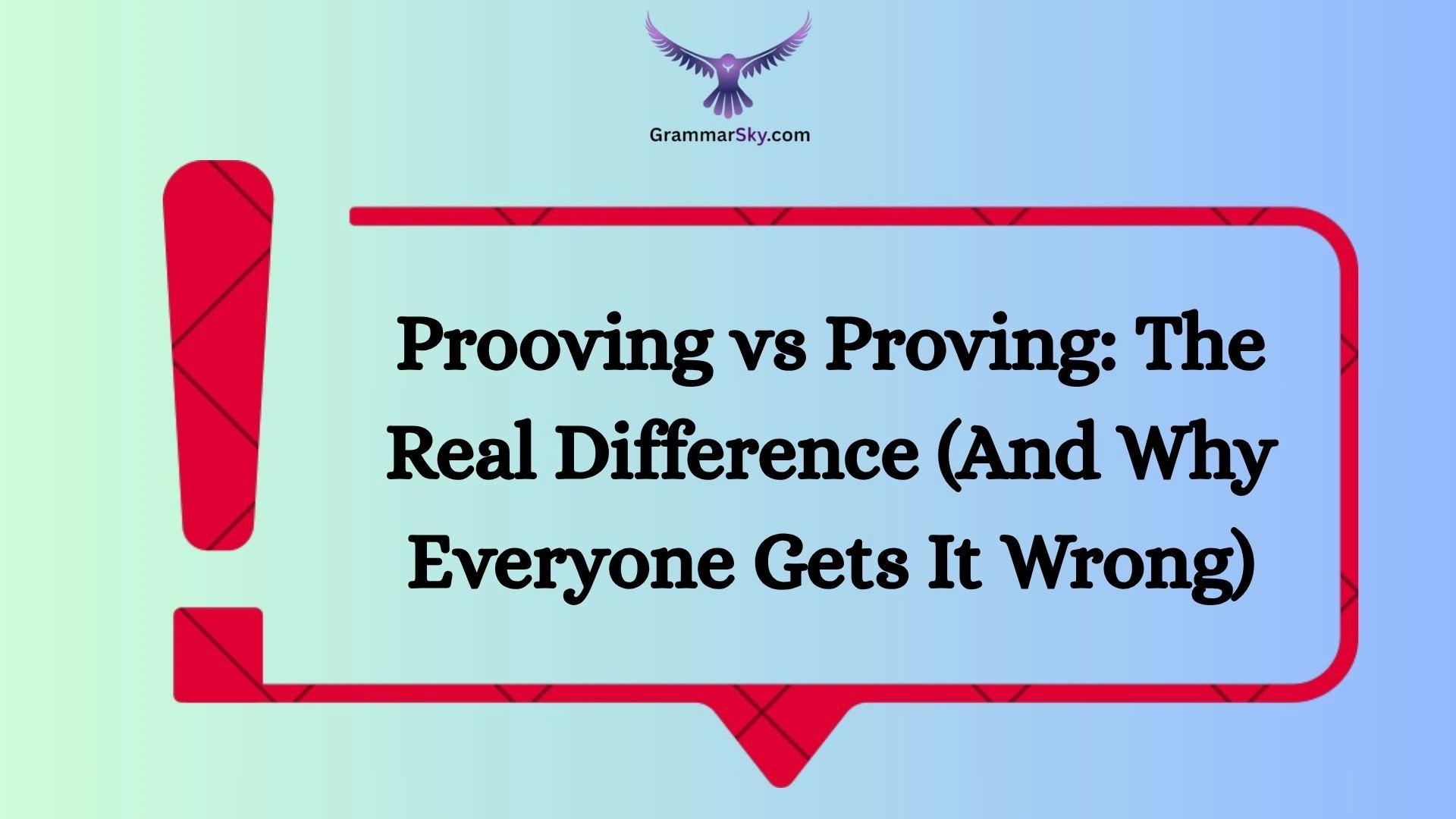
Many people confuse Prooving vs Proving because both look similar. However, only one is correct English spelling, while the other is a common misspelling.
The confusion between Prooving and Proving often happens because English spelling rules can seem inconsistent. Many learners assume that adding -ing to the verb prove requires doubling the letter o, but that is incorrect. The proper form is Proving, created by dropping the silent e before adding -ing. In contrast, Prooving is a misspelling and should never appear in formal writing, academic papers, business communication, or professional content. Understanding this simple grammar rule helps you write with greater confidence and avoid a common spelling mistake.
Knowing the difference between Prooving and Proving can significantly improve your English writing, whether you are creating blog posts, emails, reports, or social media content. Since Proving is the only grammatically correct form, using it consistently enhances your credibility and ensures your writing appears polished and professional. Learning common spelling mistakes like this also strengthens your vocabulary and editing skills. By remembering that prove simply becomes proving after removing the final e, you can avoid errors and communicate your ideas more clearly in every type of writing.
Why So Many People Write “Prooving” Instead of “Proving”
Here’s the thing: this isn’t a random typo like hitting an extra letter by accident. It’s a pattern-matching error, and honestly, it makes a weird kind of sense once you see where it comes from.
English has a whole family of words where doubling the O is exactly right. Think about:
- shoo → shooing
- woo → wooing
- boo → booing
- moo → mooing
In every one of these, the base word already ends in a doubled oo sound, and that sound just carries straight through into the -ing form. No letters get dropped. Nothing changes. You just tack on the ending.
So your brain, which is a phenomenal but occasionally lazy pattern-recognition machine, hears the “oo” sound in “prove” and assumes the same rule applies. It doesn’t. And that’s because “prove” isn’t built the same way those other words are.
The Silent E Is the Real Culprit
“Prove” ends in a silent E, not a doubled vowel. That one detail changes everything. English has a well-worn rule for verbs ending in a silent E: when you add -ing, you drop the E entirely.
Watch how consistent this is across totally unrelated words:
| Base Word | Correct -ing Form | NOT This |
| move | moving | mooving |
| love | loving | looving |
| prove | proving | prooving |
| dive | diving | deeving |
| shave | shaving | shaaving |
Nobody writes “mooving” or “looving.” It looks obviously wrong the second you see it. But because “prove” sounds a little different when you say it out loud, and because that “oo” sound is genuinely present in the pronunciation, the brain’s autopilot reaches for the wrong pattern. It’s an honest mistake, and a common one.
There’s also a second, much simpler explanation worth mentioning: typing speed and autocorrect drift. When you’re firing off a quick text or email, your fingers sometimes hit a key twice without your brain fully registering it. Spellcheck tools don’t always flag “prooving” the way they’d flag a completely nonsensical string of letters, since it still looks like a plausible English word shape. That combination, muscle memory plus lenient spellcheck, lets the error slip through more often than you’d think.
The Complete Conjugation of “Prove”
Once you understand the silent-E rule, the entire verb family falls into place. Here’s every standard form of “prove,” spelled correctly, with a natural example sentence for each.
| Form | Correct Spelling | Example Sentence |
| Base form | prove | “I always try to prove my point with data.” |
| Present participle | proving | “She’s proving her theory with new lab results.” |
| Past tense | proved | “He proved his innocence in court.” |
| Past participle | proved / proven | “The claim has been proved / proven false.” |
| Third-person singular | proves | “The evidence proves nothing on its own.” |
Notice that “proving” only ever has one O in front of it, no matter the context. That’s true whether you’re writing a legal brief, a text to a friend, or a college essay.
Proved vs Proven: The Other Confusion Worth Clearing Up
If “prooving” is the spelling problem, “proved vs. proven” is the grammar problem hiding right next to it. Here’s some good news: both words are correct. You’re not choosing between right and wrong here, you’re choosing between two accepted past participles, and the “right” one often comes down to region and sentence position.
When to Use “Proved”
“Proved” tends to show up more in:
- British English, where it’s the more traditional and widely accepted past participle
- Formal or legal writing, especially in courtroom or contractual language
- Sentences where the verb comes after “has,” “have,” or “had”
“The prosecution has proved its case beyond reasonable doubt.”
When to Use “Proven”
“Proven” dominates in:
- American English, particularly in everyday speech and writing
- Sentences where the word functions as an adjective, sitting right before a noun
“She has a proven track record of closing difficult deals.”
Here’s a quick trick that clears up 90% of the confusion: if the word comes directly before a noun, “proven” almost always sounds more natural. Compare these two:
- “a proven method” (sounds right)
- “a proved method” (sounds stiff and dated)
But when the word sits after a helping verb like “has” or “have,” either one works, and picking “proved” or “proven” often just comes down to whether you’re writing for a UK or US audience.
Words That Actually Follow the Doubled-O Pattern
To really lock in why “prove” doesn’t double its vowel, it helps to look at the words that genuinely do follow that pattern, and understand what makes them different.
These verbs end in a real, pronounced double-O sound with no silent E hiding at the end:
- shoo → shooing (as in, shooing a cat off the counter)
- woo → wooing (as in, wooing a potential client)
- canoe → canoeing (yes, this one keeps the E, but it’s a different exception entirely, tied to preserving the “oo” sound after a vowel cluster)
- coo → cooing
- boo → booing
Every single one of these words is built differently than “prove.” There’s no silent E to drop, because there’s no silent E to begin with. The double-O is baked directly into the spelling of the base word.
“Prove,” “move,” “love,” “dive,” and “shave” belong to a completely separate category: silent-E verbs. And silent-E verbs have exactly one rule, drop the E, add -ing. No exceptions, no regional variants, no gray area.
Read This Also: Vinal vs Vinyl: Which Is the Correct One to Use?
A Simple Mental Trick for Getting It Right Every Time
Here’s a mnemonic that works better than trying to memorize a grammar rule: swap in “move” or “love” and see if the pattern matches.
Try it:
- “I am proving my point” → “I am moving my point.” Same ending, same rule.
- “She is proving her theory” → “She is loving her theory.” (Sounds odd contextually, but the spelling pattern checks out.)
If a sentence with “prove” mirrors the exact same -ing construction as “move” or “love,” you’ve got the right spelling. This works because all three verbs belong to the same silent-E family, so whatever happens to one happens to the others.
Real-World Examples of “Proving” in Context
Seeing the word used correctly across different settings helps the correct spelling stick. Here’s “proving” doing its job in a few different registers:
Academic writing:
“The graduate student spent an entire semester proving her hypothesis held up under controlled conditions.”
Legal and courtroom language:
“The burden of proving guilt beyond a reasonable doubt always rests with the prosecution.”
Everyday conversation:
“You don’t need to keep proving yourself to people who’ve already made up their minds.”
Business and professional writing:
“Our team is proving the new marketing strategy works by tracking a 22% increase in conversions over the last quarter.”
Each of these examples uses “proving” as a present participle, describing an ongoing action. And in every single case, it keeps its one O, right where it belongs.
Other Common Misspellings That Follow the Exact Same Rule
Once you understand why “prooving” is wrong, you’ll start spotting the same mistake in other verbs that share “prove” as a root or follow the identical silent-E structure.
- “Improveing” instead of improving — same silent-E drop rule applies
- “Aproving” instead of approving — missing letters, but rooted in the same base verb confusion
- “Disprooving” instead of disproving — the prefix changes, the underlying rule doesn’t
None of these deserve a separate explanation. They’re all just “prove” wearing a different hat, and they all follow the same silent-E logic covered above. Once the core rule clicks, these variations stop tripping people up.
FAQs
1. Is “Prooving” a correct English word?
No, Prooving is not a correct English word. It is a common misspelling of Proving and should be avoided in all types of writing.
2. Which is correct: “Prooving” or “Proving”?
Proving is the correct spelling. It is the present participle and gerund form of the verb prove.
3. Why is “Prooving” incorrect?
The verb prove follows the standard rule of dropping the final silent e before adding -ing, resulting in Proving, not Prooving.
4. Can I use “Prooving” in formal writing?
No. Since Prooving is a misspelling, it should never be used in academic, professional, or business writing.
5. How can I remember the correct spelling?
Remember that prove becomes Proving by removing the final e and adding -ing. There is no extra “o” in the correct spelling.
Conclusion
Understanding the difference between Prooving and Proving is simple once you know the spelling rule. Proving is the correct and grammatically accepted form, while Prooving is an incorrect spelling that should always be avoided.
Using Proving correctly will make your English writing more accurate, professional, and credible. Whether you are writing emails, assignments, articles, or business documents, choosing the correct spelling helps you communicate clearly and leaves a better impression on your readers.