Separate or Seperate? is a common spelling question that confuses many English learners. Understanding the correct spelling and usage helps improve writing accuracy, communication skills, and overall confidence in English.
When deciding between Separate or Seperate?, it is important to remember that “separate” is the correct spelling, while “seperate” is a common misspelling. The word separate can function as both a verb and an adjective. As a verb, it means to divide or move things apart. As an adjective, it describes things that are distinct or not connected. Many people mistakenly write “seperate” because of the way the word sounds when spoken. Learning the correct spelling can help you avoid grammar mistakes and create more professional, polished, and credible written content.
A useful trick for remembering Separate or Seperate? is to focus on the middle part of the word. The correct spelling contains “a-r-a” in the center: separate. Practicing this spelling regularly can make it easier to recall during writing tasks. Whether you are preparing an essay, business email, blog post, or social media update, using separate correctly reflects strong language skills. Paying attention to commonly confused words like this can significantly improve your English proficiency, spelling accuracy, and overall writing quality in both academic and professional settings.
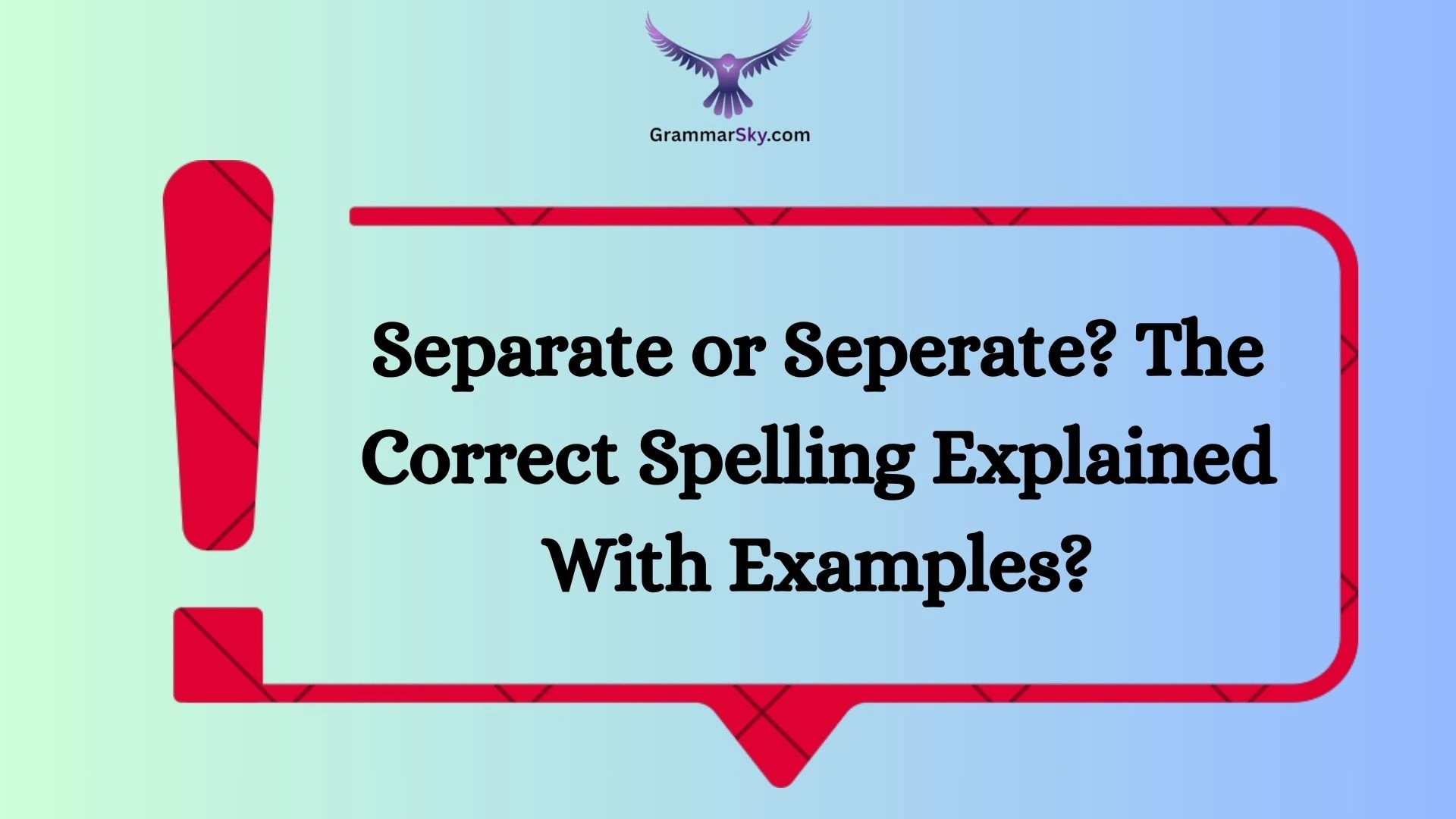
Separate or Seperate: Which Spelling Is Correct?
The correct spelling is separate.
The spelling “seperate” is incorrect in both American and British English.
Here’s the easiest way to remember it:
Sep-A-rate
The middle vowel is A, not E.
Many people accidentally type “seperate” because the word’s pronunciation sounds softer than its spelling. English pronunciation often hides vowels or blends syllables together. That creates confusion when writing.
However, dictionaries, grammar guides, style manuals, and academic institutions all recognize only one correct version:
Separate
Seperate
What Does “Separate” Mean?
The word separate means:
- To divide
- To disconnect
- To keep apart
- To distinguish one thing from another
It can work as:
- A verb
- An adjective
- Occasionally a noun
That flexibility explains why the word appears constantly in everyday writing.
You’ll see it in:
- School assignments
- Contracts
- Emails
- Legal documents
- Articles
- Technical writing
- Casual conversation
Why Do People Misspell “Separate” as “Seperate”?
This spelling mistake happens for several interesting reasons.
Pronunciation Creates the Problem
Most people don’t carefully pronounce every syllable.
Instead of saying:
sep-a-rate
Many speakers say something closer to:
- “sep-ret”
- “sep-er-it”
- “sep-rit”
The middle vowel becomes weak or nearly invisible. Naturally, writers assume the second vowel should be “e.”
That’s where “seperate” comes from.
English does this constantly. Pronunciation and spelling often move in different directions like two shopping carts with broken wheels.
The Brain Prefers Familiar Sound Patterns
Humans spell many words based on sound memory instead of visual memory.
That works fine for simpler words like:
- cat
- house
- green
But English contains thousands of irregular spellings.
For example:
| Spoken Sound | Actual Spelling |
| Definately | Definitely |
| Recieve | Receive |
| Seperate | Separate |
| Occured | Occurred |
The brain hears one thing and writes another.
Fast Typing Makes the Error Worse
Modern typing habits also contribute to the problem.
People write quickly on:
- Phones
- Laptops
- Tablets
- Messaging apps
During fast typing, the fingers often follow pronunciation patterns instead of spelling rules.
Autocorrect catches some mistakes. Others slip through unnoticed.
The Meaning of Separate as a Verb
As a verb, separate means to divide or move things apart.
Examples of “Separate” as a Verb
- Please separate the dark clothes from the white ones.
- The teacher separated the class into groups.
- Oil and water naturally separate.
- We need to separate facts from opinions.
- The highway separates the two neighborhoods.
Notice something important here.
The verb version often works with words like:
- from
- into
- by
Those combinations appear constantly in professional writing.
The Meaning of Separate as an Adjective
As an adjective, separate describes things that are independent or not joined together.
Examples of “Separate” as an Adjective
- They use separate offices.
- Keep the files in separate folders.
- The twins sleep in separate rooms.
- We ordered separate meals.
- The company created separate departments for sales and marketing.
This usage appears heavily in business, education, and legal writing.
Separate as a Noun
This usage is less common but still correct.
In fashion, “separates” refers to clothing pieces sold individually instead of as matching outfits.
Example
- The boutique sells stylish separates for workwear.
You’ll mostly hear this term in retail and fashion discussions.
How to Pronounce “Separate” Correctly
Pronunciation matters because it helps reinforce the correct spelling.
American English Pronunciation
/ˈsep.ə.reɪt/
British English Pronunciation
/ˈsep.ər.ət/
Here’s a simple breakdown:
| Part | Sound |
| Sep | Like “step” without the “t” |
| A | Soft “uh” sound |
| Rate | Like “rate” |
The key detail sits right in the middle:
That hidden vowel is “A.”
Easy Memory Tricks to Remember “Separate”
Spelling tricks work because the brain loves patterns and weird imagery.
Here are several reliable methods.
“There’s a Rat in Separate”
This famous trick actually works surprisingly well.
Look closely:
sep-a-rat-e
The word contains “a rat.”
That visual pattern helps many people lock in the correct spelling instantly.
Funny memory tricks tend to stick longer because the brain treats them like mini stories.
Think “A” for Apart
The word apart also uses the letter “A.”
Since “separate” means keeping things apart, connect the two words mentally.
- sepArate
- Apart
Both share the same important vowel.
Break the Word Into Chunks
Instead of writing the whole word quickly, mentally split it:
- sep
- a
- rate
Chunking improves spelling accuracy because the brain processes smaller pieces more efficiently.
Use Repetition in Real Sentences
Nothing beats practical usage.
Write the word naturally:
- Separate the files.
- Keep the receipts separate.
- We booked separate hotel rooms.
After enough repetition, muscle memory takes over.
Common Grammar Rules for “Separate”
Grammar mistakes often happen when writers misuse sentence structure.
Let’s clean that up.
Using “Separate” With “From”
This is one of the most common structures.
Formula
separate + object + from
Examples
- Separate the eggs from the batter.
- The fence separates our yard from theirs.
- Good leaders separate emotion from decision-making.
This structure appears heavily in academic and business writing.
Using “Separate Into”
This structure shows division into groups.
Examples
- The coach separated the players into teams.
- We separated the documents into categories.
- The scientist separated the samples into containers.
Using “Separate By”
This structure explains distance or division.
Examples
- The rooms are separated by a hallway.
- The countries are separated by a river.
- The pages are separated by tabs.
Common Prepositions Used With Separate
| Phrase | Meaning | Example |
| Separate from | Distinguish or divide | Keep sugar separate from salt. |
| Separate into | Divide into groups | Separate the students into pairs. |
| Separate by | Divide using something | The properties are separated by a wall. |
Separate vs Similar Commonly Misspelled Words
“Separate” belongs to a club of notoriously misspelled English words.
Here are some famous examples.
| Incorrect | Correct |
| Seperate | Separate |
| Definately | Definitely |
| Recieve | Receive |
| Occured | Occurred |
| Untill | Until |
| Goverment | Government |
| Calender | Calendar |
These mistakes happen because English spelling evolved from multiple languages over centuries.
Honestly, English spelling sometimes feels like three languages wearing a trench coat pretending to be one.
Real-Life Examples of “Separate” in Everyday Writing
Context helps words stick better in memory.
Here’s how people naturally use “separate.”
Separate in Daily Conversation
- We decided to keep work and family life separate.
- Please separate recyclable items from regular trash.
- They arrived in separate cars.
- The restaurant offers separate vegetarian menus.
- We sleep in separate bedrooms because of opposite schedules.
Short sentences like these make the spelling easier to remember.
Read This Also:Crow vs Raven: The Real Differences Between These Intelligent Black Birds
Separate in Academic Writing
Academic writing uses “separate” constantly.
Examples
- Researchers separated the data into categories.
- The study examines two separate variables.
- Students should submit separate assignments for each module.
- Scientists separate observations from conclusions.
Precision matters in academic communication. One spelling mistake can weaken perceived authority.
Separate in Business Communication
Professional environments rely heavily on accurate spelling.
Examples
- Please send separate invoices for each department.
- Keep confidential records in separate folders.
- The company created separate budgets for every region.
- Sales and marketing operate as separate teams.
Clear spelling creates trust. Sloppy writing does the opposite.
Why Correct Spelling Matters More Than You Think
Some people shrug off spelling mistakes. Big mistake.
Readers judge writing instantly.
A Harvard Business Review study found that communication quality strongly influences professional credibility and perceived competence.
Even small errors can create subconscious doubt.
Think about it this way:
If a restaurant menu says:
“Seperate dining area”
many customers immediately notice the typo.
Tiny error. Big impression.
Common Mistakes People Make With “Separate”
Some patterns appear repeatedly.
Let’s fix them.
Writing Based on Sound Alone
This causes the biggest problem.
English pronunciation does not reliably predict spelling.
Consider these examples:
| Word | Strange Feature |
| Wednesday | Silent letters |
| Colonel | Unusual pronunciation |
| Business | Different spoken sound |
| Separate | Hidden vowel confusion |
Trusting pronunciation alone leads to mistakes.
Forgetting the Middle “A”
This tiny vowel causes chaos.
People often type:
seper ate
seperete
seperate
The correct version remains:
separate
Depending Completely on Spellcheck
Spellcheck tools help. They aren’t perfect.
Sometimes:
- software misses context
- autocorrect creates new errors
- grammar tools overlook repeated mistakes
Good writers still proofread manually.
Confusing “Separate” With “Seperate” in Exams
Students lose marks for spelling accuracy all the time.
Teachers often treat repeated spelling mistakes as signs of weak proofreading.
That’s especially true in:
- essays
- research papers
- scholarship applications
- language exams
Correct spelling improves clarity and professionalism instantly.
Separate in British English vs American English
Some English words change spelling between regions.
Examples include:
| American English | British English |
| Color | Colour |
| Organize | Organise |
| Center | Centre |
However, separate stays exactly the same in both versions.
| Region | Correct Spelling |
| American English | Separate |
| British English | Separate |
There is no accepted variation using “seperate.”
The Origin of the Word “Separate”
Understanding word origins can improve memory.
The word comes from the Latin:
separatus
Meaning:
- divided
- detached
- withdrawn
The root contains the Latin word:
parare
which relates to preparing or setting apart.
Over time, English adopted the spelling “separate,” and it remained stable through modern usage.
That historical structure explains why the “A” belongs in the word.
How Teachers Often Explain “Separate”
Many English teachers use creative methods because traditional memorization rarely sticks.
Popular classroom tricks include:
- “There’s a rat in separate”
- Color-coding vowels
- Breaking syllables apart
- Writing the word repeatedly in context
Visual memory usually beats rote memorization.
Case Study: Why One Small Typo Hurt a Business Website
A small online retailer once used the phrase:
“Seperate payment options”
across multiple product pages.
Customers noticed the typo repeatedly.
The result?
- Lower trust
- Negative comments
- Reduced professionalism
- Increased bounce rate
After correcting spelling errors sitewide, engagement improved noticeably within weeks.
One tiny vowel quietly influenced customer perception.
That’s the hidden power of polished writing.
Quick Tricks Professional Editors Use
Editors catch spelling mistakes differently than average readers.
Here are a few techniques they use:
Read Backward
Start from the last sentence and move upward.
This forces the brain to focus on spelling instead of meaning.
Read Slowly Out Loud
Your ears catch awkward wording surprisingly well.
Search Frequently Misspelled Words
Professional editors often search documents specifically for common errors like:
- seperate
- definately
- receive
Simple habit. Huge improvement.
Separate Synonyms You Can Use in Writing
Using synonyms improves flow and reduces repetition.
Common Synonyms for Separate
| Word | Best Use |
| Divide | Splitting things |
| Disconnect | Breaking connections |
| Distinct | Showing difference |
| Independent | Functioning alone |
| Isolate | Keeping apart |
| Segregate | Separating groups |
| Split | Breaking into parts |
Choose carefully because context changes meaning.
When “Separate” Sounds More Professional Than Alternatives
Word choice affects tone.
Compare these examples:
| Less Professional | More Professional |
| Split the data | Separate the data |
| Break apart the files | Separate the files |
| Put stuff away | Keep items separate |
Professional writing often favors “separate” because it sounds precise without feeling overly formal.
Fun Facts About the Word “Separate”
Language nerds love this stuff.
Interesting Facts
- “Separate” ranks among the most commonly misspelled English words.
- Spellcheck software frequently autocorrects “seperate.”
- Many native speakers still hesitate before typing it.
- The mistake appears in academic papers surprisingly often.
Even experienced writers double-check it sometimes.
That’s normal.
FAQs
1. Which spelling is correct: Separate or Seperate?
The correct spelling is separate. The word separate is a common spelling mistake and should be avoided in formal and informal writing.
2. Why do people confuse Separate and Separate?
Many people confuse these spellings because the pronunciation can make the middle vowel sound unclear. However, the correct spelling always uses “a” in the middle: separate.
3. Is Separate ever accepted in English?
No, separate is not considered a correct English spelling. Dictionaries, grammar guides, and style manuals recognize only separate as the proper form.
4. How can I remember the correct spelling of Separate?
A helpful memory trick is to remember that separate contains “a-r-a” in the middle. Repeated practice and reading can also strengthen your spelling skills.
5. Can Separate be used as both a verb and an adjective?
Yes. As a verb, it means to divide or move apart. As an adjective, it means distinct, individual, or not connected to something else.
Conclusion
Understanding the difference between Separate or Seperate? is essential for anyone who wants to improve their English writing, spelling accuracy, and communication skills. While many people mistakenly write separately, the only correct spelling is separate. Using the right form helps your writing appear more professional, credible, and grammatically correct.
By practicing commonly confused words and paying attention to spelling details, you can strengthen your overall language proficiency and avoid unnecessary mistakes. Whether you are writing academic papers, business documents, or online content, remembering the correct spelling of separate will help you communicate with greater clarity, confidence, and accuracy.