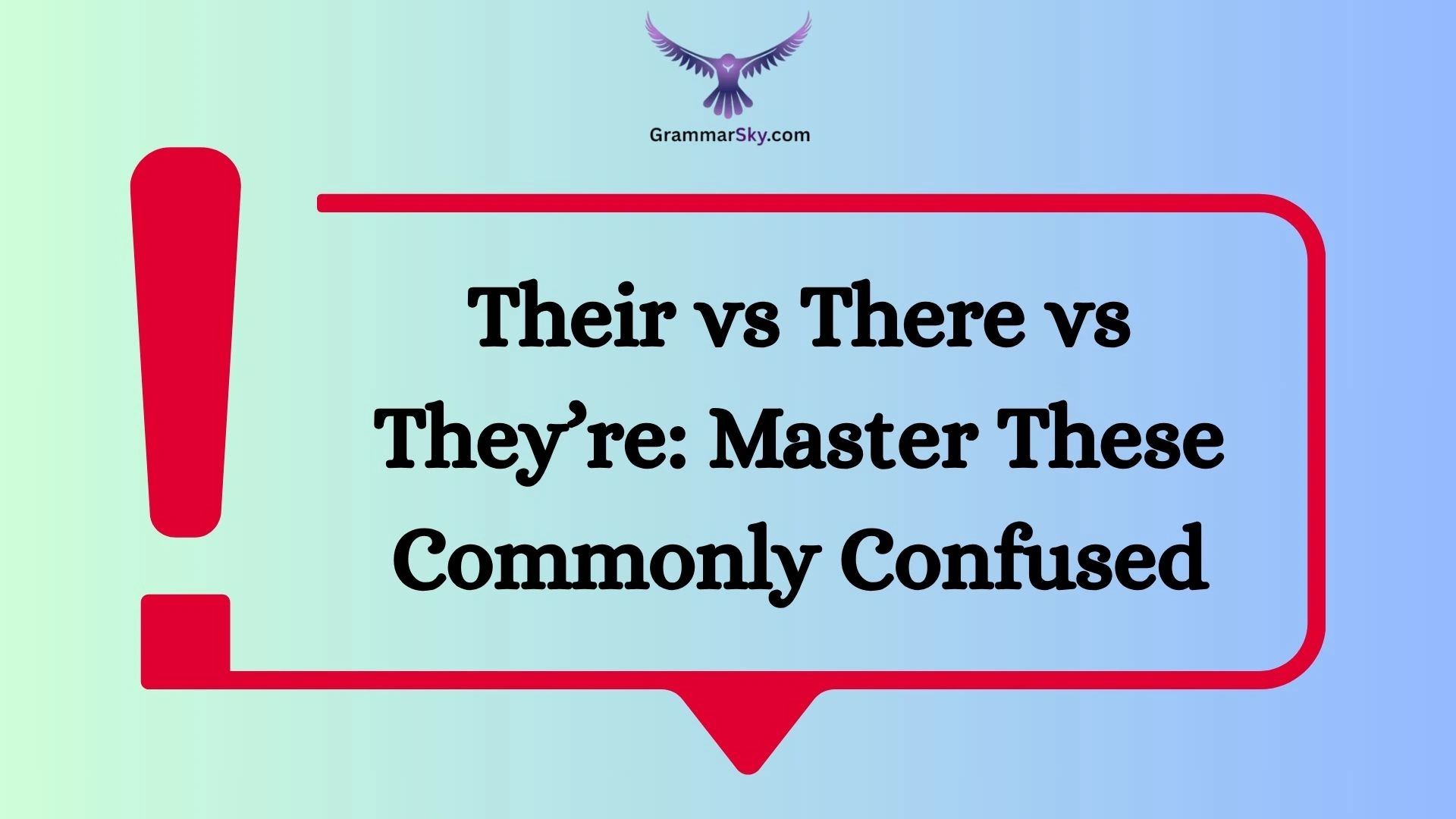
Their vs There vs They’re explains homophones through comparison, showing their as possessive, there for location, and they’re as contraction.
These word pairs can flummox students, writers, and native speakers because the sound is the same, yet different meanings depend on syntax, context, word choice, and sentence structure. In spoken English, mistakes may pass unnoticed, but in written English, correct usage, grammar rules, and usage patterns matter. I often use memory tricks, a mnemonic, and pronunciation guide methods to help learners distinguish, identify, and recognize each form, while avoiding confusion, errors, misuse, and blunders. Examples like cite and sight, flower and flour, hole and whole show how homonyms, semantic relation, lexical relation, origin, and interpretation shape meaning.
This article offers explanation, guidance, and reference through sentence examples, proofreading, and editing so users can spot what is misspelled, misused, or confusing. This particular group often appears on personal lists of grammar pet peeves, yet a comprehensive educational resource can help people learn, remember, and never mix again. Use contrast, distinction, difference, and tell apart methods to check plural, sentences, vocabulary, and usage rules. Whether reviewing Latin, studying homophone confusion, or improving communication, the goal is to use correctly, improve correctness, and build lasting resource value.
Why “Their,” “There,” and “They’re” Cause So Much Confusion
It’s not your fault. English loves throwing curveballs.
These three words are homophones. That means they sound the same when spoken. However, they carry different meanings when written.
Your brain processes sound quickly. Writing demands precision. That mismatch creates mistakes.
What’s really happening in your brain
- You hear the word → all three sound identical
- You write quickly → your brain picks the wrong version
- You don’t notice → until it’s too late
It’s like having three identical keys… but only one opens the door.
The Fastest Way to Tell Them Apart (Quick Cheat Sheet)
Let’s simplify everything into one clear table you can revisit anytime.
| Word | Meaning | Memory Trick | Example |
| Their | Ownership (belongs to them) | “Heir” owns things | Their car is new |
| There | Place or existence | Contains “here” | Sit over there |
| They’re | Short for “they are” | Expand it → they are | They’re leaving |
If you remember nothing else, remember this table.
“Their” Explained: Ownership Made Simple
Let’s start with the easiest one.
“Their” shows possession. It tells you that something belongs to a group of people.
How to recognize it instantly
If you can ask:
“Who does this belong to?”
And the answer is them, you need their.
Examples that make it click
- Their house is on the corner
- The kids forgot their homework
- The company changed their policy
Each example shows ownership. Something belongs to “them.”
A simple memory trick that actually works
Focus on the word “heir.”
An heir inherits things. Ownership.
So:
- Their → contains heir → ownership
Common mistakes people make
| Incorrect Sentence | Correct Sentence |
| There dog is loud | Their dog is loud |
| They’re car broke down | Their car broke down |
Notice the pattern? When ownership appears, “their” always wins.
“There” Explained: Location and Existence
Now let’s talk about “there.” This one does more than you think.
It handles two major roles.
Using “There” for location
When you refer to a place, use there.
Examples
- Put the bag over there
- She’s standing right there
- The restaurant is over there
Quick test
Can you replace it with “here” or point to it physically?
If yes, use there.
Using “There” to show existence
This one trips people up.
“There” can introduce something that exists.
Examples
- There is a problem
- There are many options
- There was a loud noise
In these cases, “there” doesn’t point to a place. It introduces a situation.
A helpful breakdown
| Sentence Type | Example | Purpose |
| Location | Sit there | Shows place |
| Existence | There is a solution | Introduces idea |
Common mistakes with “there”
- Their is a mistake
- There is a mistake
“They’re” Explained: Just Break It Apart
This one is surprisingly easy.
“They’re” = “they are.”
That’s it.
The foolproof trick
Expand the sentence.
If “they are” fits naturally, then they’re is correct.
Examples
- They’re going to the mall
→ They are going to the mall - I think they’re late
→ I think they are late
If the expanded version works, you’re good.
Common mistakes
| Incorrect | Correct |
| Their going home | They’re going home |
| There happy today | They’re happy today |
Side-by-Side Comparison: See the Difference Instantly
Let’s bring everything together.
Example sentence
Their car is parked over there because they’re running late.
Breakdown
- Their → Who owns the car
- There → Where the car is
- They’re → What they are doing
Another example
They’re fixing their house over there.
Each word plays a different role. Once you see it, it becomes obvious.
The 10-Second Test: Never Get It Wrong Again
When you’re unsure, run this quick checklist.
Ask yourself:
- Does it show ownership? → Their
- Does it refer to a place or existence? → There
- Can I replace it with “they are”? → They’re
That’s it. No guesswork needed.
Real-Life Mistakes (And How to Fix Them Fast)
Let’s look at mistakes you’ll actually see online.
Example 1
Their going over there
They’re going over there
Example 2
Put the bags over their
Put the bags over there
Example 3
There house looks amazing
Their house looks amazing
Pattern you should notice
Most errors happen when:
- Writing quickly
- Not double-checking
- Relying on sound instead of meaning
Read This Also.Affend or Offend? The Correct Spelling, Meaning,
Memory Tricks That Actually Stick
Forget complicated grammar rules. Use these instead.
Visual memory tricks
- Their = heir = owns things
- There = here inside = location
- They’re = they are (split it)
Think of it like this
| Word | Analogy |
| Their | Ownership key |
| There | Map pin |
| They’re | Action in motion |
These mental shortcuts work under pressure.
Practice Section: Test Yourself Quickly
Let’s make this real.
Fill in the blanks
- ______ going to enjoy this
- Put your phone over ______
- ______ friends are waiting outside
- ______ is a problem here
- I think ______ ready
Answers
- They’re
- There
- Their
- There
- They’re
Case Study: How Small Grammar Mistakes Affect Perception
Let’s look at something practical.
A hiring manager reviews two emails.
Email A
Their excited to join your company.
Email B
They’re excited to join your company.
What happens?
Email A feels careless.
Email B feels polished.
That tiny difference? It changes perception instantly.
Why this matters
- Employers notice details
- Clients judge credibility
- Readers trust clear writing
As one editor once said:
“Good grammar won’t get you noticed. Bad grammar will.”
Why Getting “Their vs There vs They’re” Right Matters
It’s not just about grammar.
It’s about clarity and credibility.
Here’s what correct usage does for you
- Builds trust instantly
- Makes your writing easier to read
- Helps you sound confident
- Avoids misunderstandings
Here’s what mistakes do
- Distract the reader
- Break flow
- Make you seem careless
And let’s be honest. People notice.
Advanced Tips Most Guides Don’t Tell You
Let’s go one level deeper.
Tip: Slow down at high-risk points
Mistakes often happen when:
- Ending sentences quickly
- Writing emails fast
- Posting on social media
Pause for one second. That’s all it takes.
Tip: Read your sentence out loud
Ask yourself:
- Does this sound like “they are”?
- Does it show ownership?
- Does it refer to a place?
Your ear often catches what your eyes miss.
Tip: Use proofreading tools—but don’t rely on them
Tools help. However, they’re not perfect.
You still need to understand the difference.
Final Recap: Lock This In
Let’s make it simple one last time.
- Their = ownership
- There = place or existence
- They’re = they are
That’s your foundation.
FAQs
1. What is the difference between their, there, and they’re?
Their shows ownership or possession, there refers to location, and they’re is a contraction of “they are.” Knowing this grammatical difference improves correct usage and reduces confusion.
2. Why are their, there, and they’re confusing?
They are homophones, meaning they have the same pronunciation and sound alike in spoken English, but their meanings, spelling, and usage are different. This often leads to mistakes, errors, and misuse.
3. How can I remember when to use each word?
Use memory tricks or a mnemonic. Connect their with ownership, there with place, and they’re with “they are.” These usage tips help learners and writers avoid commonly confused words.
4. Can proofreading help fix there, their, and they’re mistakes?
Yes. Proofreading, editing, and checking sentence structure, context, and word choice help identify and recognize incorrect forms before they become misspelled or misused in written English.
5. Are there other word pairs like their, there, and they’re?
Yes, many homonyms and word pairs cause similar trouble, such as cite and sight, flower and flour, and hole and whole. Studying these improves vocabulary, language learning, and communication.
Conclusion
Understanding Their vs There vs They’re comes down to knowing meaning, context, and proper usage. While these homophones may flummox even skilled writers, using grammar rules, comparison, distinction, and sentence examples makes it easier to distinguish each word correctly. With practice, confusion, blunders, and frequent mistakes begin to fade.
A strong habit of proofreading, using reference tools, and applying usage patterns can improve correctness over time. I have found that simple mnemonic methods, repeated examples, and attention to syntax help people remember and never mix again these commonly confused words. Good guidance and steady practice turn a tricky grammar point into a lasting skill.